In 1785, a courier riding through the Bavarian countryside was struck by lightning and killed. In his saddlebag, Bavarian authorities discovered a sealed document written in cipher. When the code was broken, the contents sent a chill through the courts of Europe: the papers were dispatches from the Order of the Illuminati, a secret society so carefully hidden that most of the public had never heard its name. Here, at last, were the rituals, the member lists, the elaborate pseudonyms — incontrovertible proof that an underground network of freethinkers had been quietly reshaping the intellectual landscape of an entire age.
The story of secret societies during the Enlightenment is not, as centuries of conspiracy theorists would have it, a story of shadowy cabals pulling the strings of history from smoke-filled back rooms. It is something stranger and more fascinating: a story about what happens when dangerous ideas need somewhere safe to live. In an era when questioning the Church could end a career, and challenging a monarch could end a life, the candle-lit lodge room became one of the few spaces in Europe where a man might speak freely.
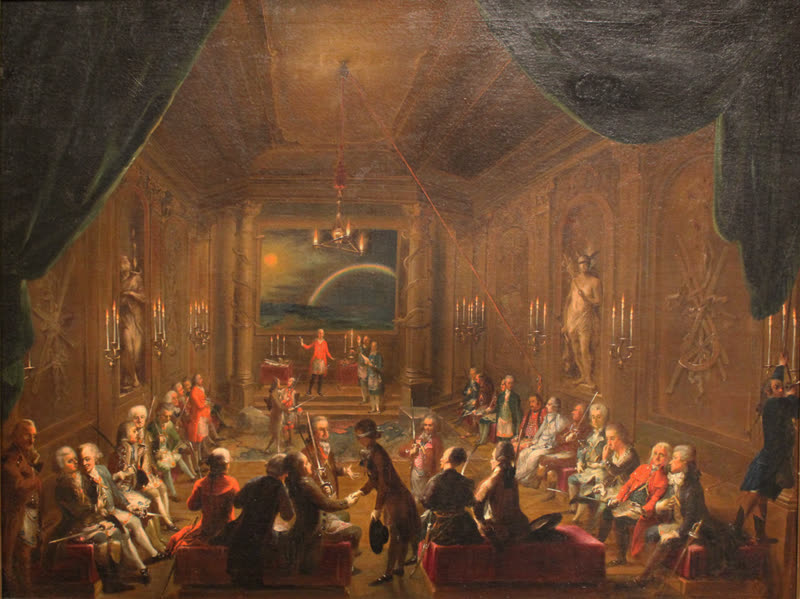
The Freemasons: Builders of a New World
To understand the secret societies of the Enlightenment, one must begin with the Freemasons — the oldest and most influential fraternal order of the modern age. Their origins lie in the medieval stonemason guilds, the brotherhoods of craftsmen who built the great cathedrals of Europe. These operative masons developed private signs, passwords, and handshakes to identify fellow guild members and protect the trade secrets of their craft. By the early eighteenth century, the guilds had transformed into something else entirely: philosophical lodges open to men of learning and social standing who had never touched a stone chisel in their lives.
In 1717, four London lodges united to form the first Grand Lodge of England, and Freemasonry as an institution was born. The appeal was immediate and obvious. The lodge offered a refuge from the rigid hierarchies of the outside world — a space governed by reason, brotherhood, and a shared belief in what members called the Supreme Architect of the Universe, a deliberately vague deity that could accommodate Christian, Deist, and heterodox theologies alike. The three degrees of initiation — Entered Apprentice, Fellowcraft, and Master Mason — were modeled on the craftsman's ascent to mastery, a metaphor for moral and intellectual self-improvement.
Within a generation, the membership rolls read like a who's who of the Enlightenment. Benjamin Franklin helped found the first American lodge. George Washington was raised to the degree of Master Mason in 1753, at a Fredericksburg, Virginia lodge, and later presided in Masonic regalia at the ceremonial laying of the U.S. Capitol cornerstone. Wolfgang Amadeus Mozart was initiated and went on to encode Masonic symbolism in The Magic Flute. And in Paris, on the night of April 7, 1778 — just two months before his death — Voltaire was initiated into the Lodge of the Nine Sisters, escorted through the ceremony by Benjamin Franklin himself.
"I have been in serious doubt as to whether there was such a thing as a truly virtuous man anywhere on earth — until I came among the Freemasons."
— Voltaire, attributed remark upon initiation, Lodge of the Nine Sisters, Paris, 1778
What did the lodges actually do? They debated philosophy, read pamphlets that would have been dangerous to discuss in public, passed resolutions on religious tolerance, and built networks of correspondence that stretched across continents. The lodge was, in many respects, a forerunner of the modern think tank — a private space for the circulation of radical ideas dressed in the ceremonial language of ancient craft.
The Bavarian Illuminati: Reason's Secret Army
If the Freemasons were the respectable face of Enlightenment secrecy, the Bavarian Illuminati were its more impatient, more radical younger sibling. The order was founded on May 1, 1776 — the same year the American Declaration of Independence was signed — by Adam Weishaupt, a professor of canon law at the University of Ingolstadt. Weishaupt was a child of the Jesuits, educated in their schools, and had come to despise what he saw as the stranglehold of the Church and the aristocracy over European thought. His solution was characteristically methodical: infiltrate the existing social structures from within, using a secret society organized along Jesuit lines but in service of radically opposite ideals.
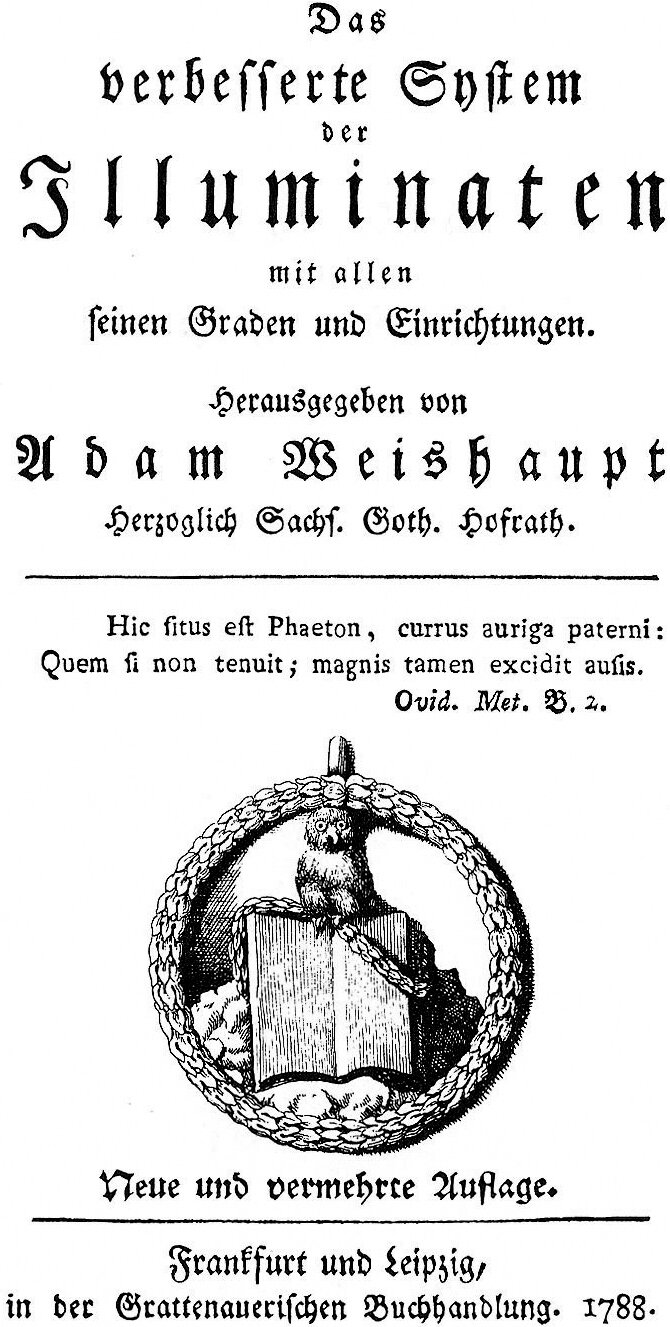
What did the secret societies of the Enlightenment actually believe, and how were they organized? In the Illuminati's case, the structure was as follows:
- Novice — The entry rank. New recruits were introduced to humanitarian philosophy and the general principles of the order, but kept ignorant of its deeper political ambitions.
- Minerval — The core rank, named for Minerva, goddess of wisdom. At initiation, the Minerval received secret signs, a password, and vowed to place the society's interests above his own.
- Illuminated Minerval — The advanced rank, where members were trusted with the order's true purposes: the abolition of superstition, the curtailment of despotic power, and the advancement of rational governance.
Weishaupt took the classical alias Spartacus, a name chosen with pointed irony — the leader of Rome's great slave revolt, now leading a rebellion of minds. His lieutenant, the diplomat Baron Adolf von Knigge (alias Philo), brought Masonic structure and connections that helped the Illuminati infiltrate existing lodges across Europe. By the early 1780s, the order had swelled to between 2,000 and 3,000 members, drawn from the nobility, the professions, and the literary world. Johann Wolfgang von Goethe and Johann Gottfried Herder were among those who moved in Illuminati circles.
All internal correspondence was conducted in cipher. Towns and provinces were given invented classical names — Munich became Athens, Austria became Egypt. Members addressed each other by their aliases alone, so that a letter written by "Spartacus" to "Philo" revealed nothing to an interceptor about its true authors or location. It was an elaborate architecture of concealment, and for nearly a decade it held.
Then came that fateful bolt of lightning in 1785. The Bavarian government, already alarmed, moved swiftly. Duke Karl Theodor issued edicts banning all secret societies in 1784 and 1785. In 1786 and 1787, authorities raided Illuminati safehouses and seized correspondence, publishing the documents to expose the order to public ridicule. Weishaupt was stripped of his professorship and banished from Bavaria. The organization was finished — at least as a functioning entity. Its legend, however, was only beginning.
The Rosicrucians: The Mystery That May Not Have Existed
Before the Illuminati, before the Freemasons reshaped themselves into philosophical lodges, there was a stranger secret society — one that may never have existed at all. In 1614, an anonymous pamphlet appeared in Kassel, Germany: the Fama Fraternitatis Rosae Crucis, or "Report of the Fraternity of the Rose Cross." It told the story of a fifteenth-century German mystic named Christian Rosenkreuz who had traveled to the Arab world, absorbed the ancient wisdom of Egypt and Arabia, and founded a secret brotherhood upon his return to Europe. The Brotherhood, the manifesto claimed, had been silently operating for over a century, healing the sick without fee, meeting once annually in a mysterious "House of the Holy Spirit," and awaiting the moment to reveal their wisdom to the world.
Two more manifestos followed in 1615 and 1616. Europe was electrified. Hundreds of would-be initiates published open letters begging to be admitted to the Brotherhood. Learned men debated the manifestos' claims in earnest. The problem was that no one could actually find the Rosicrucians. No lodge appeared, no members revealed themselves, no response ever came. Modern scholarship suggests the manifestos were written as an intellectual exercise by a circle of Lutheran scholars at Tübingen — a kind of philosophical thought experiment that escaped its authors' control and took on a life of its own. Whether Christian Rosenkreuz ever existed matters less than the fact that the idea of him did: a hidden brotherhood in possession of transformative knowledge, waiting to be discovered by the worthy seeker.
The Rosicrucian legend left deep marks. It shaped the early development of Freemasonry's higher degrees, influenced the founding of the Royal Society in England, and gave generations of intellectuals a compelling myth about the relationship between secrecy and wisdom. The ghost of Christian Rosenkreuz haunts the tradition of Enlightenment esotericism long after any historical Rosicrucian organization ceased to matter.
The Major Secret Societies of the 18th Century
The question historians still wrestle with is this: what secret societies existed during the Enlightenment, and what did they actually share? The answer reveals a world of overlapping networks, borrowed rituals, and competing visions of what a better society might look like.
- Freemasons (Grand Lodge founded 1717, London) — Key figures: Benjamin Franklin, George Washington, Voltaire, Mozart. Core belief: moral self-improvement, religious tolerance, universal brotherhood.
- Bavarian Illuminati (founded 1776, Ingolstadt) — Key figures: Adam Weishaupt ("Spartacus"), Baron von Knigge ("Philo"), Goethe. Core belief: abolition of superstition and despotism, rational governance, the primacy of reason over revelation.
- Rosicrucians (manifestos 1614–1616, Germany) — Possibly mythical founders; real influence on later Masonic degrees and scientific societies. Core belief: hidden universal knowledge, alchemy, spiritual transformation through secret learning.
- Knights Templar (legacy orders) (medieval origins, revived in Masonic "Scottish Rite" degrees, 18th century) — The disbanded military-monastic order became a powerful myth, absorbed into higher Masonic degrees and providing secret societies with a romanticized lineage stretching back to the Crusades.
- Carbonari (active c. 1800–1831, Italy) — Key figures: early Italian nationalists including the young Giuseppe Mazzini. Core belief: constitutional government, Italian unification, resistance to Napoleonic and later Bourbon rule. More political than philosophical, the Carbonari carried the secret-society tradition into the revolutionary nineteenth century.
Did secret societies influence the French Revolution? The question fascinated contemporaries and has fueled conspiracy theories ever since. The honest answer is: indirectly, yes — and not through any coordinated plot. The lodge networks spread Enlightenment ideas — equality, rational governance, the critique of inherited privilege — through exactly the class of educated professionals and minor nobles who became the Revolution's leaders. The ideas were the influence. The secret handshake was incidental.
Connection to the Archive
There is something the Archivist recognizes in all of this. The Illuminati encrypted their letters. The Freemasons used passwords and secret signs. The Rosicrucians embedded their wisdom in coded allegory. Every one of these societies understood that knowledge protected by a puzzle is knowledge that cannot be seized — that the act of decoding is itself a form of initiation.
The Archive operates on the same principle. Language, after all, is a kind of cipher. Every word carries layers: etymological sediment, metaphorical residue, the echo of every context in which it has ever been used. To unscramble a word is to hold it up to the light and see what it is made of. The Illuminati believed that only those who had earned the knowledge were ready to receive it. The Archivist believes something similar: that the moment of recognition — when the letters suddenly resolve into meaning — is not just a game mechanic but a small re-enactment of how understanding actually works.
Weishaupt's members received their aliases upon initiation: new names for new selves, identities defined by what they knew rather than by the families they were born into. Every session in the Archive is something like that — a space where all that matters is the relationship between a mind and a word, and whether you can make them meet.
The Real Legacy of Secrecy
The enduring popular image of the Illuminati — an all-powerful cabal secretly governing the world — is almost perfectly inverted from the historical reality. The real Bavarian Illuminati lasted nine years, was founded by a law professor, was suppressed by a single regional government, and left behind no documented successor organization. Its actual beliefs — opposition to religious fanaticism, support for rational governance, the equal dignity of persons regardless of birth — are not the stuff of dark conspiracy. They are the stuff of a standard university liberal arts curriculum.
What the secret societies of the Enlightenment actually built was not a shadow government. It was something more enduring: a culture of inquiry conducted in defiance of the official intellectual weather. In an age when the Church indexed dangerous books and monarchs imprisoned dangerous thinkers, the lodge room was a library that couldn't be raided, a conversation that couldn't be overheard, a circle of trust in which the most radical idea of all — that every person deserves the chance to think for themselves — could be spoken aloud without fear.
The codes have been broken, the documents published, the lodges long since opened their doors to public record. But the impulse they served remains: the need for spaces where ideas too important or too fragile to survive in the open can be kept alive, passed from hand to hand like a sealed letter, waiting for someone patient enough to read what is hidden inside.