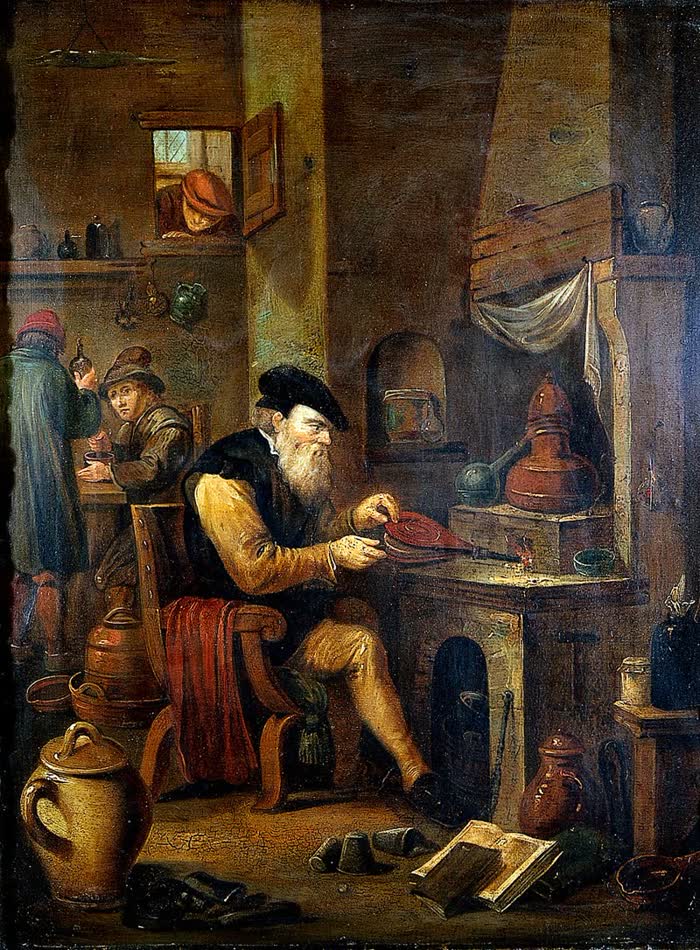
Picture the scene: a low-ceilinged chamber somewhere in medieval Europe, its air thick with the smell of sulfur and charcoal smoke. A furnace — called an athanor — glows amber in the corner, feeding steady heat to a glass alembic where some dark liquid gurgles and weeps condensation. The walls are papered with coded manuscripts, their margins annotated in cramped Latin. Wax drips from a candle onto a diagram of interlocking triangles and circles. This is the alchemist's laboratory, and it is one of the most consequential rooms in the history of alchemy — and indeed, in the history of science itself.
Alchemy is most often remembered as a failure. The gold was never made; the dead were never raised; the stone of legend was never found. But this verdict misses everything that actually happened in those smoke-filled chambers. What alchemists were doing, generation by generation, was learning how matter behaves — and that learning, however dressed in mystical language, became the foundation on which modern chemistry and medicine were built. To understand alchemy history is to understand the deep roots of science itself.
Origins: From Kemet to al-Kīmiyā
The very word alchemy carries its origins inside it. The Arabic al-kīmiyā is itself borrowed from the Coptic khem, which derives from the ancient Egyptian name for Egypt: Kemet, "the Black Land" — a reference to the dark, fertile soil of the Nile Delta. Some historians translate al-kīmiyā as "the Egyptian science," a name that points directly to where this tradition was born.
The earliest known alchemical texts emerged from Greco-Roman Alexandria in roughly the first through third centuries CE — a city that was itself a crucible of cultures, where Greek philosophy, Egyptian metallurgical knowledge, and Babylonian astrology fused into something new. Here, practical craft traditions (the dyeing of cloth, the gilding of metals, the production of artificial gems) met Platonic ideas about matter and transformation. The result was alchemy: a discipline that was simultaneously a craft, a philosophy, and a spiritual practice.
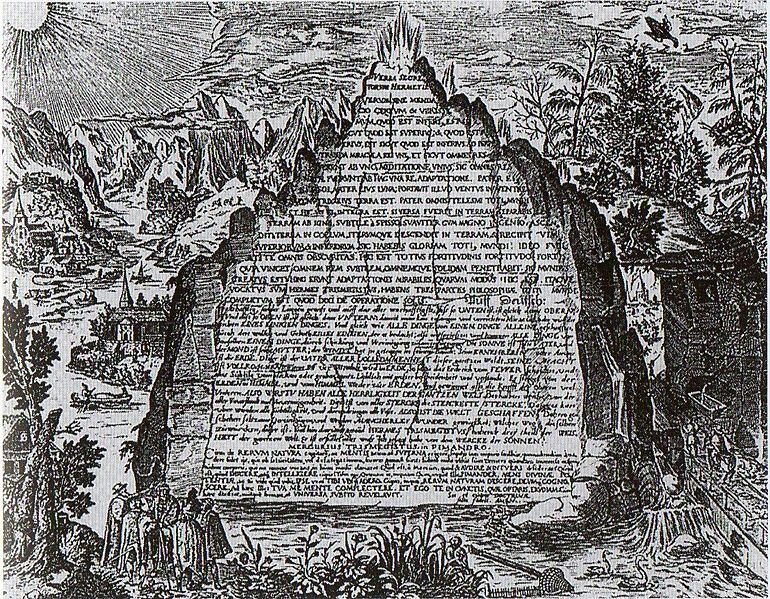
At the center of this tradition stood a legendary figure: Hermes Trismegistus, "Thrice-Greatest Hermes," a fusion of the Greek god Hermes and the Egyptian god Thoth, patron of writing and hidden knowledge. Hermes Trismegistus was credited with authoring a vast body of sacred texts — the Hermetica — and most importantly, a cryptic document that would become the founding scripture of alchemy for over a thousand years: the Emerald Tablet.
"That which is above is like that which is below, and that which is below is like that which is above, to perform the miracles of the one thing."
— The Emerald Tablet, attributed to Hermes Trismegistus (earliest surviving Arabic version, c. 8th century)
This single sentence — as above, so below — encodes the entire alchemical worldview. The cosmos and the laboratory mirror each other. To transform base matter into gold is also to transform the base self into something divine. The physical and the spiritual were never separate in alchemical thought; they were the same experiment conducted at different scales.
When Arab scholars inherited the Alexandrian tradition in the seventh and eighth centuries, they translated, expanded, and systematized it. The word al-iksir — from which we get elixir — entered this vocabulary as a near-synonym for the transforming substance itself. Arabic alchemy would carry this flame through the centuries when much of ancient learning lay dormant in Europe.
The Great Alchemists — and What They Actually Discovered
History has given us a roster of men who bent over furnaces and crucibles in pursuit of the impossible — and who, in failing to find it, discovered something more durable. The question of what alchemists actually discovered is one of the most underappreciated stories in the history of science.
Jabir ibn Hayyan (c. 721–815 CE), known in the West as Geber, was arguably the most influential alchemist of the Islamic Golden Age. Working as court alchemist to the Caliph Harun al-Rashid in Baghdad, Jabir introduced something radical: systematic experimentation. His voluminous writings describe processes including distillation, crystallization, sublimation, and calcination with a methodical precision that anticipates the modern laboratory. He synthesized hydrochloric, nitric, and sulfuric acids. He invented the alembic still — the ancestor of every distillation apparatus used today. And he developed aqua regia, the "royal water" formed by mixing nitric and hydrochloric acids, one of the only substances capable of dissolving gold. That a substance claimed to make gold could in fact dissolve it is exactly the kind of productive irony that characterizes alchemy's legacy.
Paracelsus (1493–1541), the Swiss-German physician born Philippus Aureolus Theophrastus Bombastus von Hohenheim, was a man of staggering contradictions: brilliant and insufferable, scientifically ahead of his time and deeply credulous of magic. He declared that alchemy's true purpose was not to make gold but to make medicine — and then he proceeded to do exactly that. Paracelsus introduced minerals such as mercury, sulfur, lead, copper, and antimony as pharmaceutical agents, insisting that the body itself operated on chemical principles. He named zinc as a distinct element, pioneered chemical urinalysis, and formulated what is still one of the foundational principles of pharmacology: that the dose makes the poison. "All things are poison," he wrote, "and nothing is without poison; only the dose makes a thing not a poison." He replaced Aristotle's four elements with his own tria prima — mercury (spirit), sulfur (soul), and salt (body) — a framework that described matter in terms of its properties rather than its philosophical category.
Hennig Brand, a Hamburg merchant-turned-alchemist, became in 1669 the first person in recorded history to discover a new element — though not the one he was looking for. Convinced that human urine held the secret to the philosopher's stone (its golden color seemed auspicious), Brand laboriously evaporated some 1,500 gallons of urine, reduced it to a paste, and heated it to extreme temperatures. What he collected was not gold. It was a white, waxy substance that glowed green in the dark and burst into flame on contact with air. He had isolated phosphorus — Greek for "light-bearer." The accidental discovery of a bioluminescent element, born from the most humble of materials, in a laboratory searching for immortal gold: alchemy in miniature.
Robert Boyle (1627–1691) is often cast as the man who killed alchemy by inventing chemistry. The truth is more interesting. Boyle was himself an active alchemist who corresponded with Isaac Newton about the philosopher's stone. But his 1661 work The Sceptical Chymist challenged the theoretical basis of both Aristotelian elements and Paracelsian principles, arguing instead for an empirical, experimental approach to understanding matter. He proposed something close to our modern concept of a chemical element: a substance that cannot be broken down further by experiment. He did not abandon the alchemical dream so much as rebuild its foundations — and in doing so, midwifed chemistry into existence as a distinct science.
Newton himself — yes, that Newton — wrote over a million words of alchemical notes over his lifetime, transcribed recipes for the philosopher's stone, and may have conducted extensive laboratory experiments in pursuit of the Great Work. When Cambridge University was offered his alchemical papers in 1888, they declined, embarrassed. History has since reconsidered.
The Language of Transformation: Key Alchemical Concepts
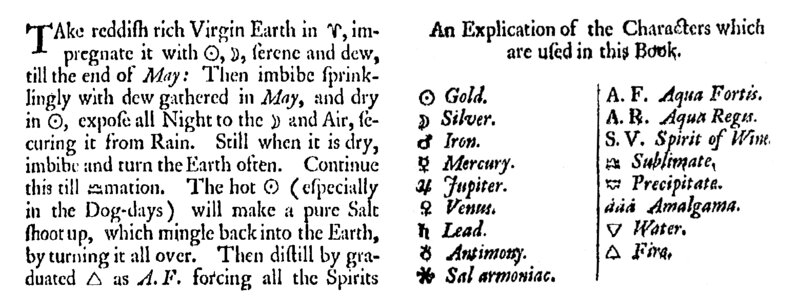
Alchemical writing is famously impenetrable — dense with allegory, coded symbols, and apparently deliberate obscurantism. But the core concepts, when decoded, reveal a sophisticated framework for thinking about matter, process, and meaning.
- Prima Materia — The "first matter." Every alchemical process began with this formless, undifferentiated substance from which all things were said to derive. Practically, it was the raw starting material; philosophically, it represented pure potential — chaos before creation. Finding and working with the prima materia was the necessary first step of the Magnum Opus, the Great Work.
- The Philosopher's Stone — The central goal and symbol of alchemy. Practically, the stone was believed to catalyze the transmutation of base metals into gold and silver. Spiritually, it represented perfection, divine illumination, and the completion of the self. The earliest known written mention appears in the Cheirokmeta of Zosimos of Panopolis, around 300 CE. Its symbol — a circle containing a triangle containing a square containing a smaller circle — encodes the entire alchemical cosmology in a single diagram.
- The Elixir of Life — Closely related to the philosopher's stone, the elixir was a liquid form of the transforming agent, capable of curing all disease and conferring immortality. The Arabic al-iksir passed into Latin as elixir, then into every European language. Every time someone speaks of an "elixir" today, they are reaching back to medieval Islamic alchemy.
- Transmutation — The conversion of one substance into another, most famously base metals into gold. Medieval alchemists believed this was possible because all metals were composed of the same underlying matter in different proportions. The philosophical reasoning was not absurd for its time; it just happened to be wrong. Nuclear physics would eventually prove that transmutation is real — merely requiring a particle accelerator, not a philosopher's stone.
- The Four Elements — Earth, water, fire, and air, inherited from Aristotle, formed the theoretical bedrock of Western alchemy. Each element possessed two of four qualities: hot, cold, wet, or dry. By adjusting these qualities — the alchemist's equivalent of chemical variables — any substance could theoretically be converted into any other.
- Nigredo, Albedo, Rubedo — The three (sometimes four) stages of the Great Work, expressed as colors: the blackening (decomposition and death), the whitening (purification), and the reddening (completion and perfection). These stages were as much psychological as chemical, a map of inner transformation superimposed on the process in the crucible.
The double register — physical and spiritual, practical and symbolic — was not a confusion or a mystification. It was the point. Alchemists genuinely believed that the processes of the laboratory reflected processes of the cosmos and the soul. To purify metal was to purify the self. The language of alchemy became the language of spiritual transformation precisely because its practitioners saw no distinction between the two.
Alchemy in the Archive
For players of The Archivist, the vocabulary of alchemy is not merely historical curiosity — it is a living lexicon woven through countless puzzles. Words like transmute, calcify, sublimate, distill, elixir, and crucible all carry their origins in the alchemist's laboratory. The symbolic alphabet of alchemy — with its planets doubling as metals (Saturn as lead, Mercury as quicksilver, Sol as gold) — contributed dozens of words to English, many of them now so absorbed into common usage that their occult ancestry is invisible.
When you unscramble a word in the Archive, you are doing something the alchemists would have recognized: taking disordered letters — the prima materia of language — and working them into their correct, perfected form. Every solved puzzle is its own small act of transformation. The Great Work, it turns out, is partly a word game.
The Transformation That Actually Happened
Alchemy did not fail. It transformed — which is, when you think about it, exactly what it set out to do.
The alchemists never made gold from lead. But in their furnaces and alembics, over fifteen centuries, they discovered phosphorus, sulfuric acid, nitric acid, hydrochloric acid, aqua regia, zinc, and the principles of distillation. They gave us the language of chemistry — alkali, elixir, alcohol (from the Arabic al-kohl), alembic, antimony, amalgam. They produced Robert Boyle's empirical method, Paracelsus's chemical medicine, and Newton's obsessive precision. They asked a question — what is the nature of matter, and can it be changed? — that turned out to be the right question. Modern chemistry, pharmacology, and materials science are the answers.
There is something worth holding onto in the alchemical spirit: the conviction that the world is not fixed, that base things can be made noble, that the pursuit of an impossible goal can generate discoveries that no modest ambition would have reached. The philosopher's stone was never found. The search for it gave us the modern world.
The furnace never went cold. It just changed its name.