Imagine lifting a single word from the page and holding it up to the light. Not reading it, not pronouncing it — examining it, the way an archaeologist brushes centuries of soil from a coin found in a field. Look closely enough and you will see the strata: a Latin root pressed beneath a French veneer, with Old Norse grit still lodged in the cracks, the whole thing resting on a foundation of Germanic stone laid down a thousand years before the printing press. This is etymology — the archaeology of words — and it is, without question, one of the most thrilling forms of detective work a curious mind can undertake.
Every word in the English language carries a provenance. Some are ancient enough to trace back to the reconstructed mother-tongue that linguists call Proto-Indo-European, spoken somewhere on the Eurasian steppe perhaps six thousand years ago. Others are brand-new borrowings, still smelling of the century they arrived in. But nearly all of them, when you dig deep enough, tell a story — of invasion, of faith, of commerce, of the slow drift of human thought across millennia. To study word origins is to read the unwritten memoir of civilization itself.
The Layers of English: A Palimpsest of Invasions
English is not so much a language as a geological event. It has been remade, layer by layer, by every conquering army and every trading route that has ever touched the British Isles. To understand why English words come from so many languages, you need only follow the timeline of invasion.
The deepest stratum is Old English — the Germanic tongue of the Angles, Saxons, and Jutes who settled Britain from the 5th century onward. These are the bones of the language: the words for the most fundamental things. Earth. Water. Fire. House. Mother. Bread. Death. Short, blunt, declarative. Words shaped by people who worked the land and named what they could touch.
Then came the Vikings. Between the 8th and 11th centuries, Norse raiders settled vast swaths of England, and their Old Norse seeped into the vernacular with surprising intimacy. Some of the most common English words are Norse in origin — they, them, their (replacing Old English equivalents), along with sky, knife, egg, window, husband, ugly, anger, and skull. The word window itself is Old Norse vindauga — literally, "wind's eye." Even the word Thursday is Thor's day, a divine name stamped into the calendar by men who believed thunder had a god behind it.
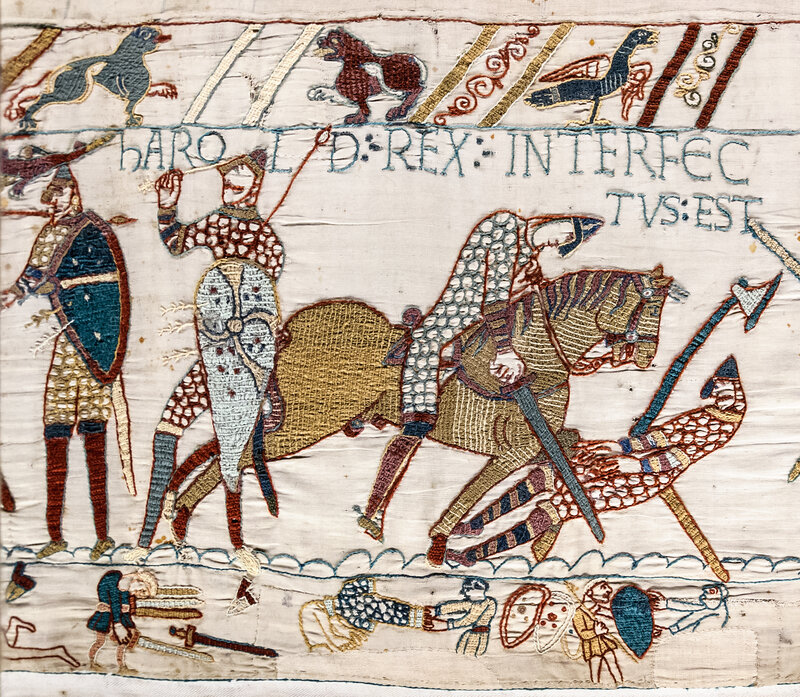
The next great upheaval arrived in 1066 with William the Conqueror and the Norman French. For centuries after the Battle of Hastings, England had two linguistic registers: French for the ruling class, Old English for the peasantry. The legacy of that class divide is still audible today. When an animal is in the field, the English farmer uses the Germanic word: cow, pig, sheep, deer. But when that animal arrives at a Norman nobleman's table, it becomes French: beef, pork, mutton, venison. Power and language have always slept in the same bed.
Woven through all of this is the thread of Latin — first from Roman occupation, then massively reinforced by the Catholic Church, and again during the Renaissance when scholars reached back to classical antiquity for the vocabulary of science, law, and philosophy. Latin gave English words like library, legal, medicine, scripture, and education. And from ancient Greek, channeled largely through Latin scholarship, came the language of thought itself: philosophy, democracy, anatomy, mathematics, theology, crisis, chaos. Greek is the language that named the things the mind reaches for when the body's vocabulary runs out.
"I discovered in [Gothic] not only modern historical philology, which appealed to the historical and scientific side, but for the first time the study of a language out of mere love: I mean for the acute aesthetic pleasure derived from a language for its own sake, not only free from being useful but free even from being the vehicle of a literature."
— J.R.R. Tolkien, A Secret Vice (1931). Tolkien was a philologist and Professor of Anglo-Saxon at Oxford before he became a novelist — and he understood, more than most, that languages are living things, not instruments.
The result of all these collisions is a language of extraordinary richness and bewildering inconsistency — a tongue with more synonyms than any other, where kingly, royal, and regal mean essentially the same thing because English absorbed the Germanic, French, and Latin versions all at once, and kept them.
Fascinating Word Excavations: 9 Origins That Rewrite Familiar Words
The finest way to understand how etymology works is to dig into specific words — to strip them back to their original meanings and watch, astonished, as the familiar becomes strange. Here are nine words whose histories are genuinely remarkable:
- Clue — When you follow a clue, you are, etymologically, following a thread. The word derives from the Old English clew, meaning a ball of yarn or thread. The original sense shift comes from the myth of Theseus and the Minotaur: Ariadne gave Theseus a clew of string to unwind through the Labyrinth so he could find his way back out. By the 1590s, "clue" had drifted figuratively to mean anything that helps you navigate confusion. Every detective following a lead is, unknowingly, unraveling thread through a mythological maze.
- Disaster — The word entered English in the 1590s from Italian disastro — literally "ill-starred," from Latin dis- (bad) and astrum (star). In the age before science, sudden catastrophes were blamed on unfavorable planetary alignments. A disaster was not merely a terrible event; it was an event caused by the malign position of a star. The entire worldview of astrology is fossilized in this single word, carried invisibly into every news broadcast about floods and earthquakes.
- Sarcasm — From the Greek sarkazein — to tear flesh like a dog, or to bite the lip in rage. The root sark- means flesh, the same root found in sarcophagus, the stone coffin literally named "flesh-eater." When you deploy a cutting remark, the Greeks would have recognized exactly what you were doing: a verbal savaging. Language has always known that the right words can wound like teeth.
- Candidate — In ancient Rome, a man seeking public office would wear a toga candida — a robe rubbed brilliantly white with chalk — to distinguish himself in a crowd and signal, symbolically, a spotless reputation. The Latin candidatus meant "dressed in white." The word candid and candor share the same root, candere, "to shine." Every politician who stands for election today is, etymologically speaking, a man in a white toga.
- Salary — Roman soldiers were sometimes given an allowance specifically to purchase salt — salarium, from sal (salt) — because salt was a precious commodity essential for preserving food before refrigeration. The Via Salaria, the "Salt Road," ran from Rome to the Adriatic coast. Salt was so critical to ancient economies that it functioned almost as currency. When we say someone is "worth their salt," we are echoing a Roman pay structure that is over two thousand years old.
- Muscle — The Romans noticed something peculiar when watching a person flex their bicep: the movement of muscle beneath skin looked like a small creature running under a blanket. They named the phenomenon accordingly — musculus, meaning "little mouse." The medical prefix myo-, used today in words like myocardium (heart muscle), comes from the Greek word mŷs, which also meant both "muscle" and "mouse." Ancient anatomists, it seems, were universally struck by the same rodent comparison.
- Nice — Today we use nice as a pleasantry so vague it barely means anything. Its origins are strikingly different. The word comes from Latin nescius — "not knowing," from ne- (not) and scire (to know, also the root of science). In 13th-century English, to call someone "nice" was to call them foolish, ignorant, or senseless. By the 14th century it meant fussy or fastidious; by the 16th century it had shifted to "precise"; by the 18th century, "agreeable." Few words have made a longer journey from insult to compliment.
- Quarantine — When Venice faced repeated waves of the Black Death in the 14th century, the city-state began requiring all incoming ships from plague-afflicted ports to anchor offshore for forty days before passengers could disembark. The Italian word for this period was quarantina — literally "forty-odd days," from quaranta (forty). The number forty carried deep religious resonance: forty days of Lent, forty years in the desert, forty days of Noah's flood. A public health measure and a theological symbol, fused into a single word that would return to daily use in 2020.
- Hazard — This word entered English from Old French hasard, which came from Spanish azar, which most etymologists trace to Arabic az-zahr — "the die" or "the dice." The word for danger is, at its root, the word for a thrown die. Risk has always been understood, at a linguistic level, as a gamble with forces beyond your control: the same roll of the bones that could grant you fortune might just as easily ruin you.
The Great Vowel Shift: Why English Spelling Is Beautifully Chaotic
If etymology is archaeology, then the Great Vowel Shift is the earthquake that scrambled all the layers. Between approximately 1400 and 1600, the pronunciation of every long vowel in English changed — a cascading transformation that linguists compare to a chain reaction, each vowel sliding into the space vacated by the one above it. The word bite once rhymed with modern beet; house once sounded like modern moose. Geoffrey Chaucer, writing in the 1380s, would have been barely intelligible to Shakespeare, born in 1564, who in turn would have struggled to understand a BBC newsreader today.
Here is the cruelty: printing arrived in England at almost precisely the moment the Shift was underway. William Caxton imported the printing press to England in the 1470s and began standardizing spelling based on the written conventions of his time — which were already failing to reflect how people actually spoke. English spelling was, in effect, frozen mid-transformation. This is why knight has a silent K and a silent GH; why enough and though and through are all spelled with the same four-letter ending but pronounced entirely differently. Each silent letter is a ghost of a sound that once existed, an artifact of a language caught changing and preserved in amber by Caxton's press.
The chaos of English spelling is not a failure of the language. It is its history, written in plain sight.
Every Word Puzzle Is an Excavation Site
Within The Archivist, every scrambled word you encounter is not merely a cipher to decode — it is a fragment of sedimentary language, compressed under centuries of use. When you turn the letters of a word over in your mind, searching for the pattern within the disorder, you are performing, in miniature, the same act as the etymologist: looking past the surface form of a thing to find the logic hidden underneath.
The word puzzles of the archive draw from the same deep wells that have fed the English language for a millennium. Latin roots embedded in scientific and philosophical vocabulary; Greek structures underlying the language of medicine and reason; Old Norse cadences in everyday words so familiar we have forgotten they were ever foreign. To unscramble a word is to reassemble a small piece of history — to restore a thing to its correct shape, if only for a moment.
The Archivist knows this. Every word in the collection has its own provenance, its own trail of clew-thread leading back through the labyrinth of centuries. The puzzle is never just about letters.
Closing: Words Are Living Fossils
There is a concept in palaeontology called a living fossil — an organism so well adapted to its environment that it has remained essentially unchanged for hundreds of millions of years. The coelacanth. The horseshoe crab. Language has its own version of this phenomenon. When you say "disaster," you are using a word that still carries the imprint of a culture that believed stars controlled human fate. When you call someone a "candidate," you are invoking the memory of chalk-dusted Roman togas. When you follow a "clue," you are holding, invisibly, the thread Ariadne pressed into the hand of Theseus at the entrance to the dark.
Every time you speak, you carry voices with you. Latin senators arguing in the Forum. Norse raiders who named the wind's eye in a ship's hull. French nobles who brought the language of cuisine and court across the Channel. Greek philosophers who reached for words to describe the shape of thought itself. They are all here, lodged in the language like fossils in stone — waiting for anyone curious enough to brush away the surface and look.
Etymology is not a dry academic exercise. It is a form of time travel available to anyone with a dictionary and the patience to ask: where did this come from? Ask that question long enough, and the entire history of human civilization will answer.