Somewhere in the back rooms of a great natural history museum, pressed between two sheets of acid-free paper, a flower holds its shape across three centuries. Its pigment has faded from scarlet to rust, its petals dried to the consistency of parchment, yet the precise vein-work of each leaf remains as legible as the day an illustrator bent over it with a horsehair brush. Botanical illustration has always been this: the marriage of scientific precision and artistic devotion, a discipline where the eye must be trained to see what the mind already loves. To study its history is to trace, in ink and watercolour, the long human effort to name, classify, and understand the living world — and, more secretly, to speak its hidden language.
The roots of botanical illustration reach back to antiquity. Crateuas, court physician to Mithridates VI of Pontus in the first century BCE, is credited with the earliest known illustrated herbal — a work so carefully observed that its images were copied and recopied for nearly a millennium afterward. But copying, inevitably, accumulated error. By the time those copies reached the scriptoria of medieval Europe, the plants had become symbols rather than specimens: stylized, heraldic, drained of the biological information that had made them useful. Monks reproduced images they had never compared to living plants, and the result was a botanical literature in which the illustrations were increasingly ornamental rather than instructive. Pliny the Elder complained, as early as the first century CE, that many plant drawings had grown so remote from reality that they could no longer be used for identification.
The Renaissance changed everything. In the 1530s, the German physician Otto Brunfels published his Herbarum Vivae Eicones — Living Images of Plants — illustrated by Hans Weiditz, an artist who held the radical conviction that a plant should be drawn exactly as it appeared: wilted leaves and all, damaged specimens faithful to the specific organism before him rather than to any idealized type. This break with symbolic tradition was the founding gesture of modern botanical illustration. In 1543, Leonhart Fuchs published De Historia Stirpium, with woodcuts of such clarity and elegance that they remained in circulation for over a century. Leonardo da Vinci and Albrecht Dürer had already demonstrated, in studies of star-of-Bethlehem and the Great Piece of Turf respectively, that the natural world repaid the closest possible attention. What Brunfels and Fuchs added was systematic purpose: botanical illustration in service of science, of medicine, of the great project of naming the living world.
The Art of Botanical Illustration: Science in Service of Beauty
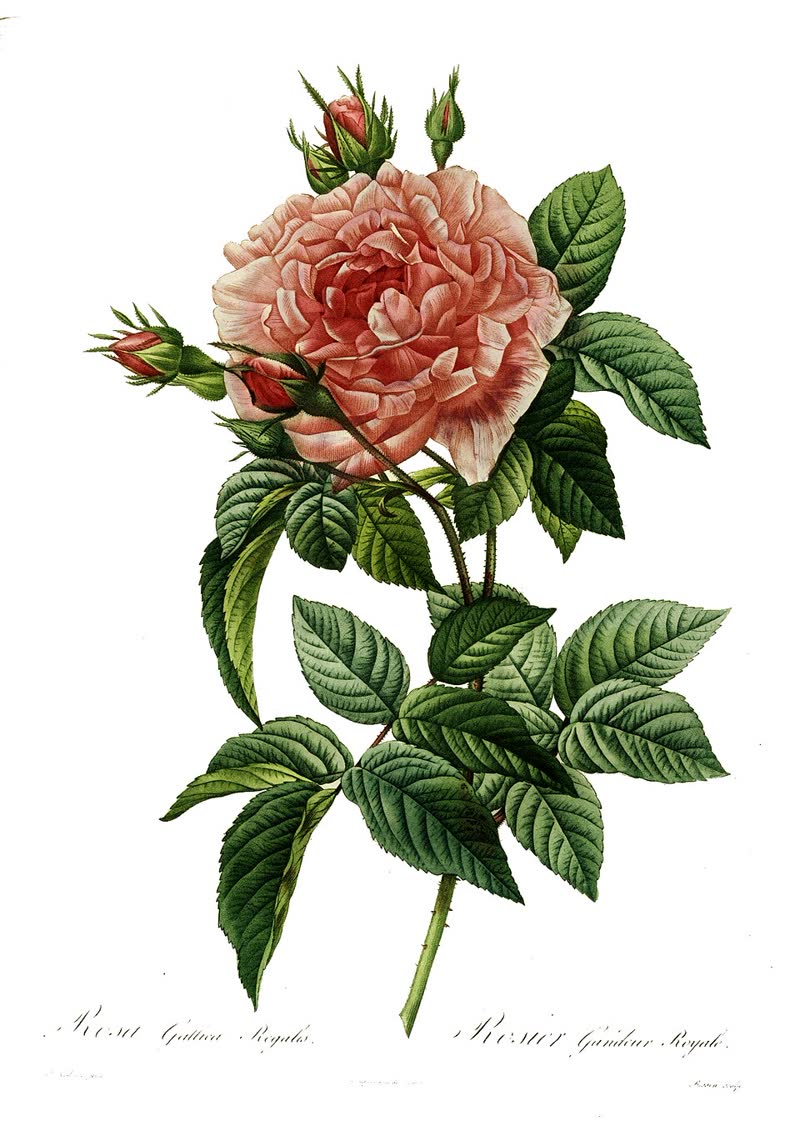
The golden age of botanical illustration arrived with an unlikely patron: Empress Joséphine of France. At her estate of Malmaison outside Paris, Joséphine assembled the most remarkable private rose garden in Europe — over two hundred and fifty varieties — and commissioned Pierre-Joseph Redouté (1759–1840) to document every one of them. Redouté, a Belgian-born artist who had trained under the collections at the Jardin des Plantes, had already earned the nickname "the Raphael of flowers" from his peers. Working from living plants rather than dried specimens — a practice that preserved the freshness and subtle translucency of petals — he produced over 2,100 published plates depicting more than 1,800 different species, many rendered for the first time. His masterwork Les Roses (1817–1824) remains perhaps the most celebrated botanical publication in history.
What made Redouté extraordinary was not merely his technical virtuosity but his understanding of what botanical illustration required: that scientific accuracy and aesthetic beauty were not competing values but inseparable ones. An illustration that failed to capture the exact arrangement of stamens was useless to a botanist; an illustration that failed to convey the luminous quality of a rose petal was a failure of a different order. Redouté achieved both. He survived the Revolution, the Terror, and the fall of Napoleon while queens, empresses, and duchesses vied to be taught watercolour by him. He is said to have died as he had lived: examining a white lily, brought to him on what would be his last morning.
Across the Channel and the Atlantic, a very different botanical illustrator was rewriting the possibilities of what the discipline could be. Maria Sibylla Merian (1647–1717), born in Frankfurt to a family of engravers and artists, had been studying and drawing insects since childhood. In 1699, at the age of fifty-two and accompanied only by her younger daughter Dorothea, she sold her paintings to fund a voyage to Suriname — a Dutch colony on the northeast coast of South America — to document its natural world. No European woman had ever undertaken such an expedition on purely scientific grounds. The resulting publication, Metamorphosis Insectorum Surinamensium (1705), was unlike anything that had come before: sixty engraved plates showing insects, plants, lizards, and frogs in their living ecological relationships rather than as isolated specimens on a white ground. Merian did not merely illustrate plants; she illustrated systems. A caterpillar on the leaf it fed on; a flower surrounded by the butterfly it attracted. In doing so, she anticipated the concept of the food chain by two centuries.
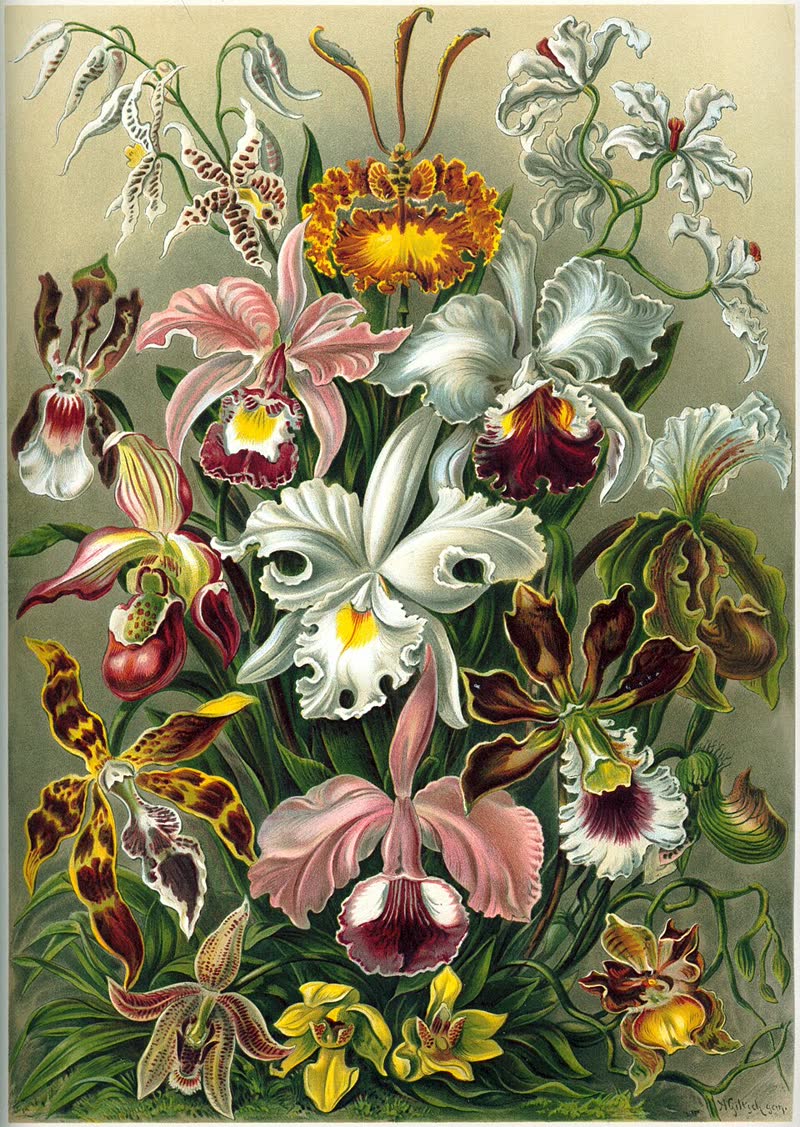
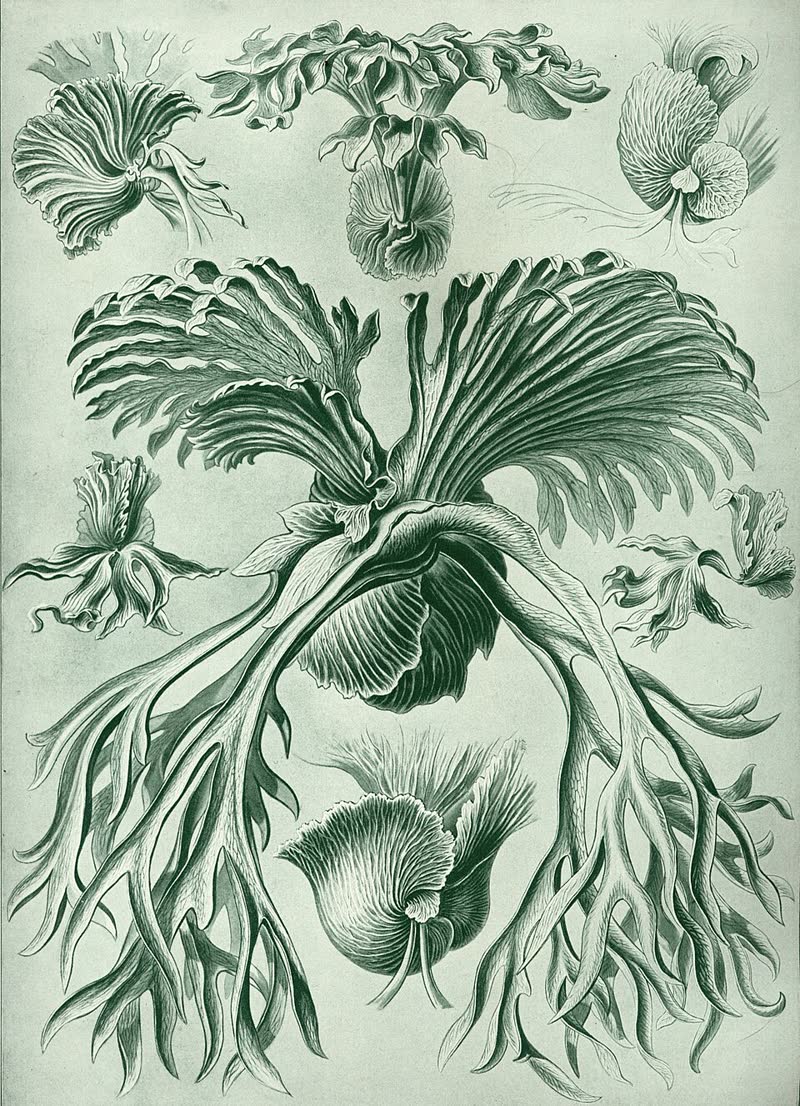
A century after Merian, Ernst Haeckel (1834–1919) brought to botanical and natural illustration a quality that bordered on the mystical. A German biologist and philosopher-naturalist, Haeckel was less interested in individual specimens than in the underlying mathematical beauty he believed governed all living forms. His Kunstformen der Natur (Art Forms in Nature, 1899–1904) — one hundred lithographic plates covering everything from radiolarians to orchids to ferns — was not simply a scientific publication but a manifesto about the relationship between science and art. Haeckel argued, and demonstrated, that the organic world possessed an intrinsic aesthetic intelligence: that the spiral of a nautilus shell, the radial symmetry of a jellyfish, the fractal branching of a fern were not accidents of biology but expressions of some deeper formal logic. His plates were profoundly influential on the Art Nouveau movement; René Binet used them as direct inspiration for the monumental gateway of the 1900 Paris Exhibition. In Haeckel's hands, botanical illustration became a form of natural philosophy.
"Nature is the art of God."
— Carl Linnaeus, Systema Naturae, 1735
The Language of Flowers: What Is Floriography?
To understand the Victorian language of flowers — what scholars call floriography — it helps to begin not in England but in Turkey. The tradition of sélam, the use of objects to carry coded messages, flourished in Ottoman court culture in the early eighteenth century. When the poet and traveller Lady Mary Wortley Montagu visited Constantinople in 1716–1718, she encountered this practice and described it in letters that would later circulate widely across European intellectual society. The idea — that objects, including flowers, could stand in for spoken words in a culture where direct communication was constrained — found fertile ground in the drawing rooms of Victorian England.
What made floriography genuinely Victorian, however, was the marriage of this imported idea to the era's two great passions: botany and sentiment. The nineteenth century was the age of the flower dictionary. Joseph Hammer-Purgstall published what appears to be the first systematic floral vocabulary in 1809; Charlotte de la Tour's Le Langage des Fleurs appeared in 1819 and was widely imitated. In England and America, such books proliferated through the 1820s and 1830s, creating a shared system of floral symbolism that, while never entirely standardized, gave educated Victorians a common code. Armed with these dictionaries, Victorians exchanged small arranged bouquets called nosegays or tussie-mussies that could, if correctly composed and correctly read, communicate entire sentences. A bouquet given with the right hand meant "yes"; presented with the left, it meant "no." Flowers held upright conveyed one meaning; inverted, the opposite.
Some of the more resonant Victorian flower meanings include:
- Red rose — passionate love (the rose's association with Venus and romantic love stretches back to classical antiquity; floriography simply formalized what poetry had always known)
- Rosemary — remembrance (Shakespeare had Ophelia speak this meaning into existence: "There's rosemary, that's for remembrance")
- Forget-me-not — true love and fidelity (the name itself carries the message, a quality of economy the Victorians appreciated)
- Yellow carnation — disdain or rejection (yellow, in Victorian symbology, often carried negative connotations — a too-bright substitute for gold)
- Violet — humility and modesty (connected to the Virgin Mary, violets carried religious associations that preceded floriography by centuries)
- Ivy — fidelity and friendship (its clinging habit made it a natural symbol of attachment)
- White lily — purity and majesty (simultaneously sacred and regal, carrying both religious and courtly associations)
- Anemone — forsaken or anticipation (the inconsistencies between dictionaries were themselves a kind of code, known only to the educated)
But floriography was not merely a parlour game for the upper classes. It encoded, in the language of plants, precisely those emotions that Victorian society was least equipped to speak plainly. A woman who could not publicly acknowledge her feelings could send a bouquet. A rejected suitor could receive a yellow carnation and understand immediately. There was something elegiac about the whole enterprise: a recognition that direct language was inadequate to the full weight of feeling, that flowers — beautiful, transient, rooted in the soil — might speak more truly than words.
The Herbarium: A Library of Dried Lives
Behind every great botanical illustration lies an even more humble archive: the herbarium. The word comes from the Latin hortus siccus — "dry garden" — and the practice of pressing, drying, and mounting plant specimens for scientific study dates to the Renaissance. Luca Ghini, a professor of botany at Bologna and Pisa in the 1540s, is credited with the earliest known herbariums; by the eighteenth century, such collections had become indispensable to botanical science. Carl Linnaeus himself, the great Swedish naturalist who devised the binomial nomenclature system that still names every species on Earth, wrote in his Philosophia Botanica (1751) that "a herbarium is better than any illustration; every botanist should make one." The pressed specimen, in Linnaeus's view, was irreplaceable evidence — matter itself, rather than the representation of matter.
And yet the illustration and the herbarium were not competitors but collaborators. The specimen provided the scientific fact; the illustration made it communicable, memorable, beautiful enough to study. The great herbaria of the world — at Kew, at the Natural History Museum in London, at the Smithsonian — now hold nearly 400 million specimens between them, a planetary archive of plant life that spans centuries. Some of those specimens were the direct source material for the most celebrated botanical illustrations in history. When Redouté bent over a rose at Malmaison, he was in a sense making a living herbarium entry — capturing in watercolour what pressed paper would lose: colour, texture, the precise fall of morning light on a petal.
The naturalist's practice of pressing flowers into books — a habit that persists even now, however informally — is perhaps the most intimate form of this archiving impulse. A pressed flower is a kind of pause button on the world, an insistence that beauty should not be entirely subject to time. It is also, in the context of floriography, a love letter that never expires: the flower's meaning, if one knew the code, preserved indefinitely between the pages of a book.
Botanical Illustration in the Archive
For players of The Archivist, the vocabulary and imagery of botanical illustration wind through the game's puzzles like a climbing vine. The names of flowers — their Latin binomials and their English common names alike — have always been a rich stratum of the language, accumulated across centuries of taxonomy, poetry, herbalism, and floriography. The game's broader naturalist aesthetic, with its evocations of dried specimens and glass-stoppered jars, of field notes in cramped handwriting and illustrated folios open on lectern desks, draws directly on this tradition: the idea that the natural world is both a subject of scientific inquiry and a text to be read, annotated, puzzled over.
When you work through an arrangement of letters in the Archive, you are doing something that the botanical illustrators would have recognized. They spent their careers bringing order to apparent chaos — identifying a new species from a tangle of undifferentiated tropical vegetation, fixing its characteristics in ink, assigning it a name, a position in the great Linnaean hierarchy. The puzzle-solving impulse and the taxonomic impulse are versions of the same gesture: the determination to find the structure hidden inside disorder. Every flower has a name. Every name, unpicked, has a history. The Archive is full of them.
The Persistence of the Beautiful Science
Botanical illustration never died — it transformed. When photography arrived in the nineteenth century, many assumed it would make the botanical illustrator obsolete. Instead, the discipline adapted, finding new purposes that the camera could not serve. A photograph captures a single specimen on a single day; an illustration can synthesize the characteristic features of a species, showing the flower open and closed, the seed pod mature and immature, the root system extending below the soil. Scientific illustration today remains indispensable to taxonomy, conservation biology, and field identification — and it remains, in its finest examples, an art form of the highest order.
More than that: the tradition established by those Renaissance herbalists and Golden Age flower painters continues to shape how we see the natural world. We tend to look at flowers the way we have been taught to look at them — with Redouté's eye for translucency, with Haeckel's eye for symmetry, with Merian's eye for ecological context. The language of flowers, meanwhile, however fractured and inconsistent it may have been even in its Victorian heyday, survives in fragments everywhere: in the roses at a funeral, the forget-me-nots pressed into a locket, the single violet tucked into a letter that says nothing and means everything.
There is something in the pressed flower's endurance that feels like a kind of argument: that beauty and meaning are not wasted on transient things. The orchid dried between two sheets of paper is gone and not gone. The illustration made from it persists. And in the language of flowers — in the idea that natural forms might carry human meaning as surely as any word — there is a conviction that the world is not merely data to be collected but a text to be read, if only we take the trouble to learn the alphabet.