There is a number hidden inside every living thing. You will find it in the arrangement of seeds in a sunflower's face, in the branching of veins beneath your skin, in the nautilus shell coiled like a watchspring on the ocean floor. It is approximately 1.618. The ancient Greeks called it the "extreme and mean ratio." Luca Pacioli, the Renaissance mathematician who collaborated with Leonardo da Vinci, called it the "divine proportion." Today we call it phi — and for millennia it has stood at the beating heart of sacred geometry: the conviction that the universe was designed according to geometric principles so perfect, so harmonious, that they must have originated in some divine mind.
To pursue sacred geometry is to enter a strange corridor where mathematics and mysticism stop being opposites — where the geometer's compass becomes a theological instrument, where a proportion between two lengths becomes evidence for the existence of God. It is a tradition that runs unbroken from the smoke-filled schoolrooms of Pythagorean Greece to the soaring vaults of Gothic cathedrals to the notebooks of Renaissance artists who believed they could hear the music of the spheres encoded in the diagonals of a regular pentagon.
The Ancient Roots: Numbers as Divine Language
Long before the golden ratio had a name, it had a presence. Ancient Egyptian architects oriented the Great Pyramid of Giza toward true north with an accuracy modern engineers struggle to replicate. The builders of Mesopotamia encoded astronomical cycles into the proportions of their ziggurats. But it was in ancient Greece, in the mathematically charged air of the fifth and fourth centuries BCE, that sacred geometry became a formal philosophy.
Pythagoras of Samos — founder of a school that was simultaneously a mathematics academy and a religious brotherhood — believed that numbers were not merely tools for counting. They were the substance of reality. "All is number," he declared, and he meant it literally. The Pythagoreans identified specific geometric forms with cosmic principles: the point was unity; the line was duality; the triangle was the simplest complete form; the circle was perfection, without beginning or end. The pentagram — a five-pointed star drawn in a single continuous line — was the school's sacred symbol, and it concealed within its proportions a ratio the Pythagoreans understood to be exceptional: the ratio we now call golden.
The formal mathematical definition came later, from Euclid. In his Elements (c. 300 BCE) — arguably the most influential mathematical text ever written — Euclid described what he called the "extreme and mean ratio": a line divided into two unequal segments such that the ratio of the whole line to the longer segment equals the ratio of the longer segment to the shorter. This sounds abstract until you feel it in your hands. It means that whatever is cut in this proportion contains itself — the smaller reflects the larger, the part mirrors the whole. Euclid recognized that this ratio governed the construction of the regular pentagon, the icosahedron, and the dodecahedron. It was not just a curiosity. It was structural.
Plato, writing in his dialogue Timaeus around 360 BCE, took the next step. He proposed that the cosmos had been designed by a divine craftsman — the Demiurge — using five perfect solids as the building blocks of matter. These five forms, now called the Platonic solids, are the only three-dimensional shapes whose faces are identical regular polygons. Plato assigned each one to an element:
- The Tetrahedron (four triangular faces) — associated with fire, the most penetrating element.
- The Cube (six square faces) — associated with earth, stable and grounded.
- The Octahedron (eight triangular faces) — associated with air, light and mobile.
- The Icosahedron (twenty triangular faces) — associated with water, fluid and yielding.
- The Dodecahedron (twelve pentagonal faces) — associated with the cosmos itself. Of this solid, Plato wrote obscurely: "God used it for arranging the constellations on the whole heaven."
The dodecahedron is built from pentagons — and therefore saturated with the golden ratio, since a pentagon's diagonals always divide in that divine proportion. In Plato's cosmology, God had literally used phi to stitch the stars into their patterns. Every side of every pentagonal face was cut in the extreme and mean ratio. The heavens were a golden solid.
The Renaissance Revelation: De Divina Proportione
The golden ratio circulated for nearly eighteen centuries after Euclid — studied by Arab mathematicians, applied by architects, embedded in geometric proofs — but never quite crystallizing into a cultural obsession. Then, in 1509, something changed. A Franciscan friar and mathematician named Luca Pacioli published De Divina Proportione — "On the Divine Proportion" — a book that would alter the way Renaissance Europe understood beauty, God, and geometry.
Pacioli was a man of extraordinary milieu: a friend of Piero della Francesca, an algebra teacher, and a close collaborator of Leonardo da Vinci. He called the golden ratio "divine" for five reasons, each more rhapsodic than the last. The proportion was unique, as God is unique. It was a triune unity — expressible in three related quantities — as God is the Trinity. It was irrational and inexpressible, as God is beyond human comprehension. It was ever-present in proportion, as God is omnipresent. And it was self-sustaining: the ratio that contains itself, world without end.
"Geometry has two great treasures: one is the theorem of Pythagoras; the other, the division of a line into extreme and mean ratio. The first we may compare to a measure of gold; the second we may name a precious jewel."
— Johannes Kepler, letter, 1609
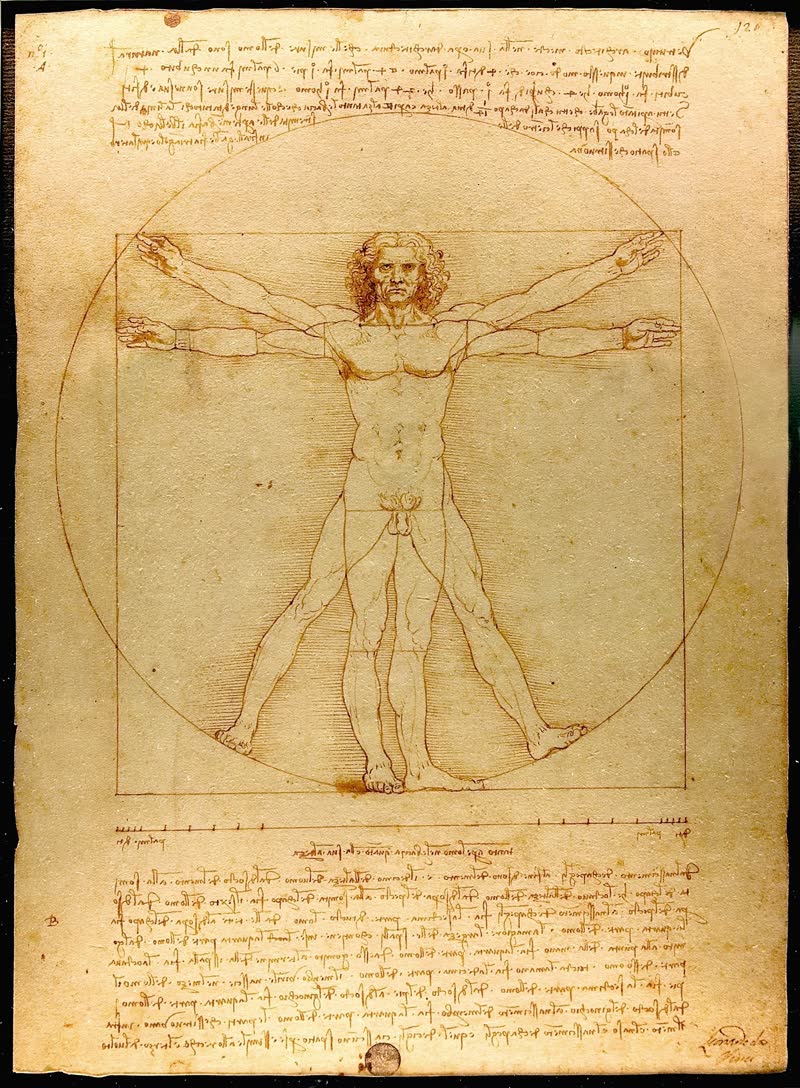
The illustrations for De Divina Proportione were drawn by Leonardo da Vinci himself — extraordinary three-dimensional renderings of the Platonic solids, the earliest technical geometric illustrations in European printing history. Leonardo's most celebrated drawing from this period is the Vitruvian Man, completed around 1490: a male figure inscribed simultaneously within a circle and a square, the two forms the Roman architect Vitruvius had declared most perfect. The image is commonly cited as a golden-ratio diagram. In fact, as Pacioli himself acknowledged, its proportions are based on Vitruvius's own measurements of ideal human anatomy — but the philosophical claim is the same: the human body is a microcosm of universal order, and that order is geometric.
When Johannes Kepler turned to cosmology in his 1596 Mysterium Cosmographicum, he proposed that the six known planets moved in orbits nested around the five Platonic solids, one inside another like a celestial puzzle box — the octahedron between Mercury and Venus, the icosahedron between Venus and Earth, the dodecahedron between Earth and Mars, the tetrahedron between Mars and Jupiter, the cube between Jupiter and Saturn. It was architecturally breathtaking. It was wrong. But it was the first serious attempt since Copernicus to argue that the heliocentric model was physically real, and its error was dressed in the conviction that God had built the cosmos to a geometric plan — which is, in its way, a conviction that was not entirely without descendants.
The Fibonacci Sequence: Nature's Secret Blueprint
In 1202, a young Italian mathematician named Leonardo of Pisa — later nicknamed Fibonacci, "son of Bonacci" — published a book called Liber Abaci, "The Book of Calculation." It was primarily a manual introducing Hindu-Arabic numerals to European merchants. But buried in a chapter about rabbit population growth was a sequence of numbers so elegantly recursive that its deepest implications would not be fully appreciated for centuries.
The sequence is simple: begin with 1 and 1. Each subsequent number is the sum of the previous two. 1, 1, 2, 3, 5, 8, 13, 21, 34, 55, 89, 144 — and so on, forever. Fibonacci himself did not notice anything particularly remarkable about the ratios of consecutive terms. He was computing rabbit pairs, not cosmic patterns.
What the Pythagoreans had intuited, and what Kepler confirmed in a letter of 1609, is that the ratio of any Fibonacci number to the one before it converges, as the numbers grow larger, toward the golden ratio. Divide 144 by 89 and you get 1.6179. Divide 233 by 144 and you get 1.6180. The deeper you go into the sequence, the closer you approach phi — that irrational number whose decimal expansion runs forever, spiraling toward 1.618033988... without ever arriving.
Nature had been computing this sequence long before Fibonacci wrote it down. The arrangement of seeds in a sunflower follows clockwise and counterclockwise spirals that almost always appear in consecutive Fibonacci numbers — 34 spirals one way, 55 the other, or 89 and 144 in an especially large head. The petals of many flowers occur in Fibonacci numbers: lilies have 3, buttercups 5, delphiniums 8, ragwort 13. The scales of a pinecone, the bumps of a pineapple, the branching of a tree — all tend toward this ancient sequence. The reason is efficiency. Plants that arrange leaves and seeds at the golden angle — approximately 137.5 degrees, derived directly from phi — maximize exposure to sunlight while minimizing overlap. The golden ratio is not mystical decoration: it is an elegant solution to a packing problem, encoded in the DNA of living things across hundreds of millions of years of evolution.
Sacred Geometry in Stone: Temples, Cathedrals, and the Golden Mean
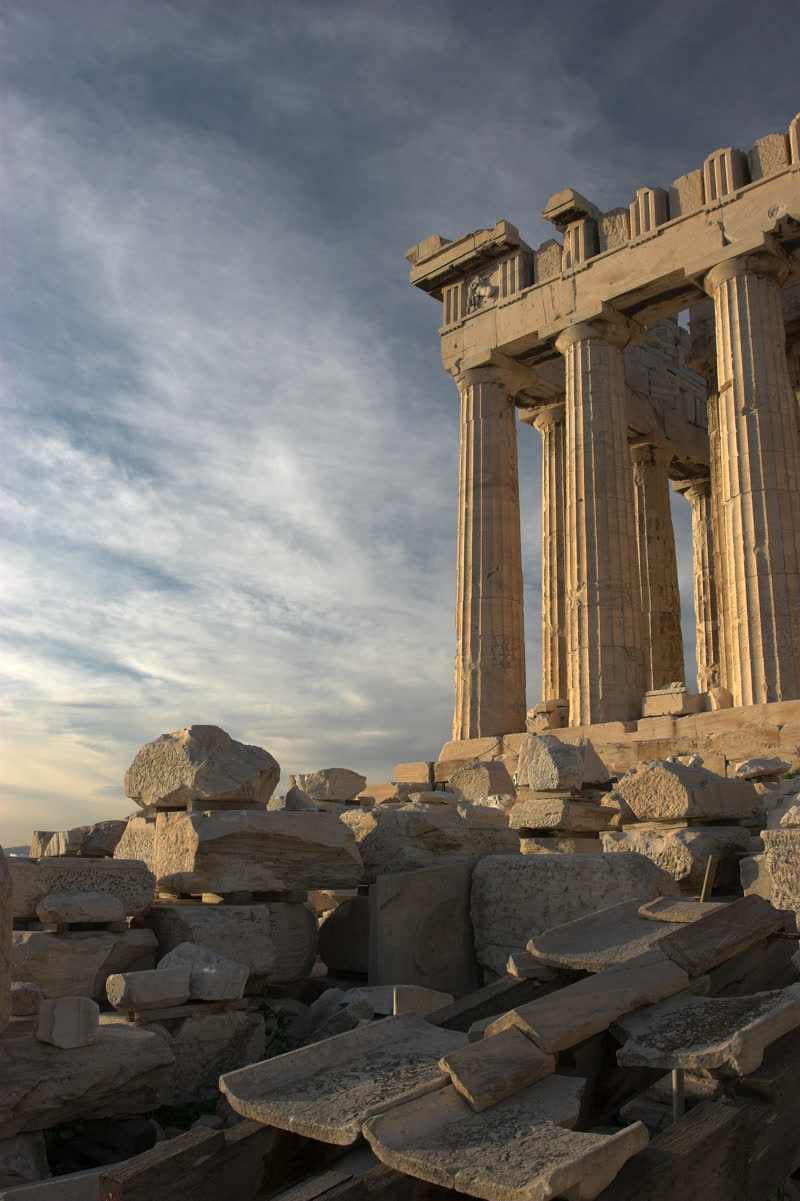
The idea that great buildings encode sacred proportions is ancient, persistent, and — in many cases — well documented, even if individual claims are sometimes overstated. Walk toward the Parthenon in Athens, built between 447 and 432 BCE under the direction of Phidias, Iktinos, and Kallikrates, and you will understand why the debate persists. The building has a quality that photographs fail to capture: a rightness, as though the stones have been arranged in the only possible order, as though any other configuration would be not merely different but wrong.
Scholars have debated for centuries whether the Parthenon's dimensions were deliberately constructed around the golden ratio. The measurements are suggestive — the ratio of the facade's width to its height approaches phi — but the architects left no written records of their intentions, and the Parthenon predates Euclid's explicit formulation by more than a century. What can be said with confidence is that the building embodies a system of proportions of extraordinary mathematical sophistication: a web of deliberate ratios between columns, entablature, and pediment that gives the whole its sense of inevitable harmony.
Medieval cathedral builders were more explicit. The masons who raised the Gothic cathedrals of Europe in the twelfth and thirteenth centuries operated within a tradition of sacred geometry passed down through guild apprenticeships, its technical knowledge guarded as carefully as any trade secret. A Gothic cathedral was not merely a church: it was a diagram of the cosmos, its proportions mirroring heavenly order. The master builders used what they called "regulating lines" — invisible geometric scaffolding that governed every element of the design. The square, the equilateral triangle, the circle were not decorative choices but structural theology. When a medieval stonecutter inscribed a circle and a square in a single figure — as Leonardo would do in the Vitruvian Man two centuries later — he was not ornamenting a surface. He was asserting a cosmological claim: that the earthly and the divine could be held, simultaneously, within the same geometric form.
The rose windows of Notre-Dame de Paris, the soaring vaults of Chartres, the labyrinthine floor patterns of Amiens — all were constructed with mathematical precision intended to make the building itself a form of theological argument. Light streaming through those great windows was understood as the presence of God, and the geometry that organized those windows was the mind of God made visible in stone.
What the Numbers Actually Say: Sacred Geometry and the Limits of Pattern
Perhaps the most compelling question sacred geometry raises is not whether phi was built into the Parthenon, or whether Kepler's nested solids reflected divine intention, but whether the golden ratio is genuinely embedded in the structure of the natural world — and if so, what that means.
The evidence, examined carefully, is both more and less spectacular than the popular mythology suggests. The Fibonacci spirals in sunflower seeds and pinecone scales are real, documented, and mathematically precise. The occurrence of Fibonacci numbers in flower petal counts is statistically robust. The golden angle does govern the spiral growth of many plants, and it does arise directly from phi. These are genuine patterns — not projections of wishful thinking onto random data.
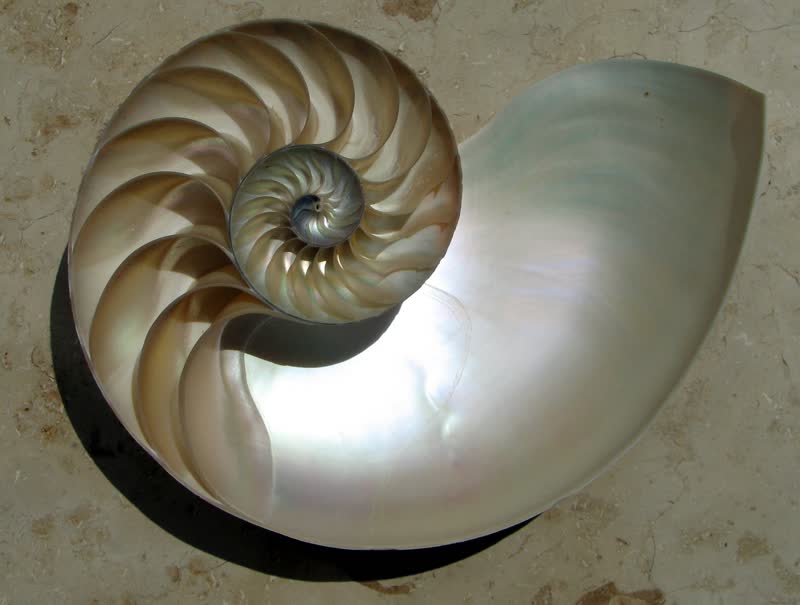
The nautilus shell is more complicated. It is, unambiguously, a logarithmic spiral — a spiral that maintains a constant angle as it expands, so that each new chamber resembles all previous chambers in proportion. This self-similarity is itself astonishing, a visible record of growth that changes size without changing shape. But measurements of actual nautilus shells find ratios ranging from roughly 1.24 to 1.43, with an average around 1.33 — notably not the golden ratio of 1.618. The nautilus is a logarithmic spiral, but not necessarily a golden one. The myth has outrun the measurement.
This is the perpetual tension at the heart of sacred geometry: the patterns are real, but the human mind is exquisitely prone to finding what it seeks. We are, as a species, extraordinarily good at detecting ratios, symmetries, and spirals — even when the correspondence is approximate, or coincidental, or produced by selecting which measurements to include. The history of sacred geometry is a history of genuine mathematical discovery entangled with genuine projection.
And yet. The golden ratio does emerge from the purely abstract mathematics of the Fibonacci sequence. It does appear in the geometry of the regular pentagon and the Platonic solids — the solids that fascinated Plato, Kepler, and generations of thinkers who found in them evidence of divine design. It does govern the growth patterns of plants in ways that confer real evolutionary advantages. The cosmos contains phi. The question of what that means remains, as it always has been, both a mathematical and a philosophical problem — which may be exactly as Pythagoras intended.
Sacred Geometry in the Archive
For players of The Archivist, the vocabulary of sacred geometry is a living archive of encrypted meaning. Words like proportion, ratio, symmetry, and harmony carry their mathematical origins wherever they travel — into music theory and aesthetic philosophy, into architectural criticism and molecular biology. The very word geometry descends from the Greek for "earth measurement," and the act of measuring the earth, in every civilization that has done it, has quickly become an act of locating the divine within the terrestrial.
The puzzle traditions of sacred geometry — the dissection of the square, the construction of the pentagon with compass and straightedge, the nesting of circles and spirals — have their analogue in every word puzzle that asks you to find the hidden order inside apparent chaos. To rearrange the letters of a scrambled word is to perform a small act of geometric recovery: finding the perfect form concealed within disordered elements. The same impulse that drove Euclid to define the golden ratio, that drove Kepler to nest his Platonic solids inside planetary orbits, that drove the medieval mason to inscribe his regulating lines before laying the first stone — the conviction that beneath the surface there is always a hidden structure, always a proportion that makes everything right — is the same impulse that keeps a player reaching for one more puzzle, one more arrangement, one more hidden word waiting to be found.
The Proportion That Persists
There is a thought experiment worth carrying with you. Take any line. Divide it so that the shorter part relates to the longer as the longer relates to the whole. You have now performed an act that Egyptian builders may have known, that Greek mathematicians formalized, that Renaissance scholars called divine, that nature enacts in every sunflower and every spiral shell. You have found — or made — the golden proportion.
No one has ever fully explained why this particular ratio appears so persistently, in sunflower spirals and cathedral blueprints, in the mathematics of pentagons and the growth of living cells. The evolutionary argument explains some appearances and not others. The perceptual argument — that humans find golden proportions beautiful because they reflect the natural patterns we evolved to recognize — is plausible but unproven. The mystical argument, that phi is the proportion God used to design the universe, is unfalsifiable by definition. And yet the ratio keeps turning up, connecting the abstract world of pure mathematics to the concrete world of seeds and shells and stones.
The golden ratio is approximately 1.618. It is irrational — its decimal expansion runs forever, without settling into a pattern, without stopping. Perhaps that is the most sacred thing about it: the sense that no matter how precisely you measure, the answer recedes just ahead of you, ratio within ratio, an infinite regress of perfect proportion that the mind can approach but never quite contain. The line has been cut. The proportion is exact. The mystery remains.