Imagine a room — a very large room, though the word hardly does it justice — where the smell of papyrus hangs in the air like incense. Row upon row of wooden shelves line the walls, each one dense with scrolls: thousands of them, tens of thousands, eventually hundreds of thousands, their cylindrical ends tagged with small clay labels bearing the names of their authors. Euclid. Archimedes. Sappho. Hippocrates. Aristotle. The contents of entire civilizations compressed into rolled sheets of reed-pulp, shelved here in Ptolemaic Egypt under a roof built expressly to hold the sum of human knowledge. This was the Library of Alexandria — the most ambitious intellectual project the ancient world ever attempted, and the most consequential thing it ever lost.
The Library was not merely a building that housed books. It was an argument — a statement in stone and papyrus that knowledge could be gathered, organized, and studied in one place; that the scattered wisdom of Greece, Egypt, Babylon, Persia, and India could be made to speak to itself; that civilization was cumulative rather than fragmented. For perhaps four centuries, that argument held. Then it didn't. What happened in between — and what we actually lost when the argument collapsed — is one of the great unresolved questions of history, and one of its most instructive tragedies.
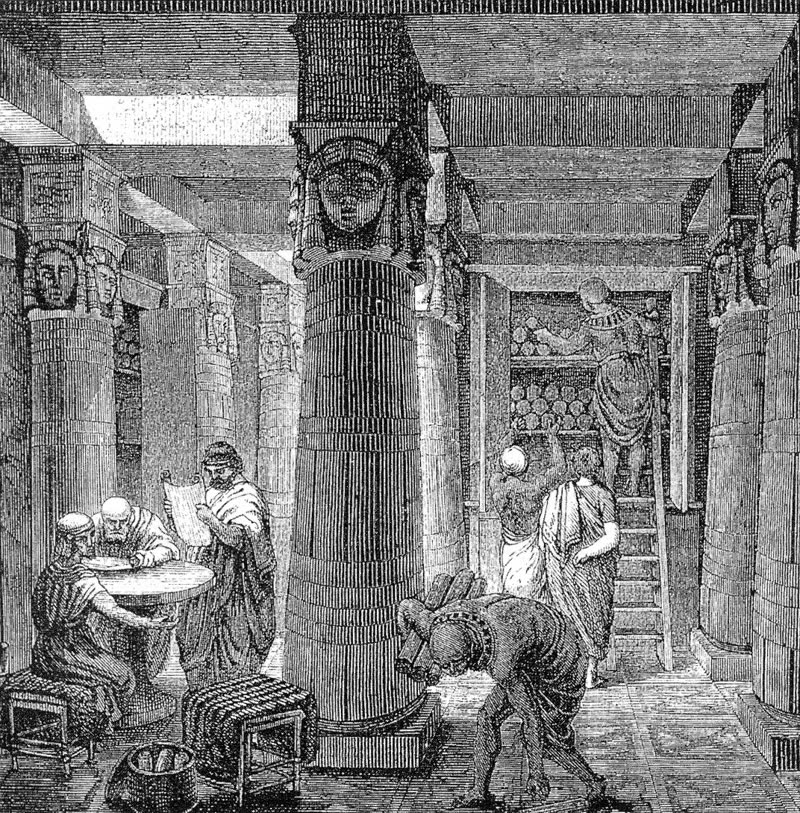
The Architecture of Ambition: Building the Library of Alexandria
The Library did not spring into existence fully formed. It grew, over generations, from an idea that was itself a product of conquest. When Alexander the Great died in 323 BC, his empire fractured among his generals. Egypt fell to Ptolemy I Soter, a Macedonian commander who understood that legitimacy in his new kingdom required more than military force — it required cultural prestige. He founded Alexandria on the western edge of the Nile Delta, on a site Alexander himself had chosen, and set about making it the most dazzling city in the Mediterranean world.
The Library emerged from this imperial ambition. Its architect in spirit, if not in stone, was Demetrius of Phalerum — an exiled Athenian statesman and student of Aristotle's successor Theophrastus, who arrived at Ptolemy's court around 297 BC. Demetrius had seen the private library Aristotle had assembled in Athens, perhaps the finest collection of books in the Greek world at the time, and he proposed something vastly larger: a state-funded archive whose explicit purpose was to collect every book ever written, in every language. The royal decree was, in its way, magnificently audacious: acquire all knowledge. Leave nothing out.
Ptolemy's son, Ptolemy II Philadelphus, was likely the ruler who turned this vision into a physical institution. The Library was built inside the Mouseion — the Temple of the Muses — in Alexandria's royal Brucheion quarter. The Mouseion functioned as something between a research institute and a university: resident scholars received free housing, food, and generous salaries from the royal treasury in exchange for advancing learning. To attract them, the Ptolemies created conditions that no private patron could match. To fill the shelves, they deployed methods that no modern library would dare attempt.
Ptolemy II issued a decree that any books found on ships docking in Alexandria's harbor were to be confiscated, copied by the Library's scribes, and returned — eventually — to their owners. The originals stayed. He reportedly borrowed the official Athenian state copies of Aeschylus, Sophocles, and Euripides on a deposit of fifteen talents of silver — an enormous sum — and then simply kept them, forfeiting the deposit without apparent regret. Royal agents traveled to the great book fairs of Athens and Rhodes with instructions to buy whatever they could find, and to prefer older copies, reasoning that fewer transcriptions meant fewer corruptions from the original. At its height, the Library of Alexandria is estimated to have held between 400,000 and 700,000 papyrus scrolls — the equivalent, modern scholars suggest, of roughly 100,000 modern books.
"He wished to collect, if possible, all the books in the inhabited world, and if he heard of or saw any book worthy of his programme, he had it bought."
— Letter of Aristeas, describing the acquisitions policy of Ptolemy II Philadelphus (c. 180–145 BC)
The collection was organized — for the first time in recorded history — by the poet and scholar Callimachus of Cyrene, who compiled the Pinakes (Tables): a 120-scroll bibliographic catalog of the Library's holdings, organized by genre and author. The Pinakes were the first library catalog in the Western tradition, and they are themselves lost. We know they existed primarily because later scholars quoted them. The catalog of a lost library, itself lost — the irony is almost too perfect.
The Scholars of the Mouseion: What Was Discovered Inside Those Walls
To understand what burned, you first have to understand what was built. The Mouseion was not a passive repository — it was a place of active, extraordinary intellectual production. The scholars who worked there, subsidized by Ptolemaic gold and surrounded by more texts than any individual could read in a lifetime, accomplished things that the world would not see again for over a millennium.
- Euclid — working in Alexandria around 300 BC, Euclid assembled the Elements, thirteen books synthesizing Greek geometry into a logical framework so rigorous it would remain the standard mathematical textbook for over two thousand years. It is one of the few Alexandrian works that survived, copied and recopied across the centuries.
- Eratosthenes of Cyrene — the Library's third head librarian, Eratosthenes calculated the circumference of the Earth in the third century BC with a method of breathtaking simplicity. Knowing that the Sun shone directly into a well at Syene at noon on the summer solstice while casting a shadow in Alexandria, he measured the shadow's angle (about 7.2 degrees, or one-fiftieth of a full circle), multiplied the measured distance between the two cities by fifty, and arrived at roughly 40,000 kilometers. His answer was, by modern calculations, correct to within a few percent. The manuscript in which he recorded his methods is lost.
- Aristarchus of Samos — working in Alexandria around 280–260 BC, Aristarchus proposed that the Earth orbits the Sun, not the other way around. He calculated the relative sizes of the Earth, Moon, and Sun. His heliocentric manuscripts were not preserved, surviving only as a brief reference in Archimedes' Sand Reckoner. The world would wait eighteen centuries for Copernicus to rediscover what Aristarchus had already proved.
- Herophilus of Chalcedon — the anatomist who conducted the first known systematic dissections of human cadavers, identifying the brain as the seat of intelligence, distinguishing arteries from veins, and describing the nervous system with accuracy that would not be matched until the Renaissance. His works are entirely lost.
- Apollonius of Rhodes — the Library's second head librarian, whose Argonautica remains one of the few Alexandrian literary works that have come down to us intact, a reminder of how much was left behind only by accident of survival.
These names represent the tip of a submerged archive. Callimachus's Pinakes listed works by hundreds of authors now known to us only as names in fragments, or not at all. The Library held, by all accounts, the complete dramatic output of Aeschylus, Sophocles, and Euripides — the full texts of every play they wrote. We now possess seven plays by Aeschylus out of roughly ninety, seven by Sophocles out of perhaps one hundred and twenty, and eighteen or nineteen by Euripides out of perhaps ninety-five. What we consider the canon of Greek tragedy is a thin survival, not a representative sample. The Library once held all of it.
The Long Dying: How the Library of Alexandria Was Actually Destroyed
Here is where the popular myth diverges from the historical record, and where the truth proves stranger and more sobering than any single conflagration. The Library of Alexandria was not destroyed in one night. It was erased over centuries, through a compound of fires, political neglect, religious violence, and the quiet entropy that overtakes any institution when its patrons stop caring.
The first major blow came in 48 BC, when Julius Caesar, besieged in Alexandria during his support of Cleopatra against her brother Ptolemy XIV, ordered ships in the harbor set ablaze to prevent them being used against him. The fire spread to the docks and, according to later accounts — notably the playwright Seneca quoting the historian Livy — destroyed some 40,000 scrolls stored near the waterfront. Whether these were part of the main Library collection or a commercial book depot remains disputed. Caesar's fire damaged, but did not erase.
The second blow was quieter: the slow withdrawal of royal patronage. When Rome absorbed Egypt in 30 BC after Cleopatra's death, the Mouseion no longer had a Ptolemaic monarch funding it with almost limitless generosity. Roman emperors maintained it but did not lavish it. Scholars' stipends grew uncertain. The Library's membership, according to surviving accounts, appears to have largely ceased by the 260s AD. By then, Alexandria had endured two further military catastrophes: in 270–275 AD, the emperor Aurelian destroyed the Brucheion quarter — the Library's home — in retaking the city from Queen Zenobia of Palmyra; and in 297 AD, Diocletian's siege again devastated the same district. If any significant collection survived to this point, these events likely finished it.
A daughter library, established in the Temple of Serapis — the Serapeum — may have outlasted the main collection by a century. In 391 AD, the bishop Theophilus of Alexandria, acting under a decree from the Christian emperor Theodosius, led a mob against Alexandria's pagan temples. The Serapeum was destroyed. Whatever scrolls remained there were dispersed, burned, or simply abandoned. The philosopher Hypatia, who worked and taught in Alexandria at this time and whose murder in 415 AD by a Christian mob has come to embody the period's violence against learning, was almost certainly working from a city already stripped of its greatest library.
Later Arabic sources — writing centuries after the fact — blamed the Arab conquest of Alexandria in 642 AD, claiming that the Caliph Umar ordered the Library burned on the grounds that any book agreeing with the Quran was superfluous, and any book disagreeing with it was heretical. Most modern scholars consider this account a legend, invented long after the fact for polemical purposes. By 642, there was likely nothing left to burn.
The real answer to why was the Library of Alexandria destroyed is not a single villain or a single fire. It is institutional decay across seven centuries — the gradual failure of the systems that create and sustain the conditions for collective knowledge. The Library was not murdered. It was abandoned, repeatedly, by successive powers who decided there were more pressing concerns than the preservation of scrolls.
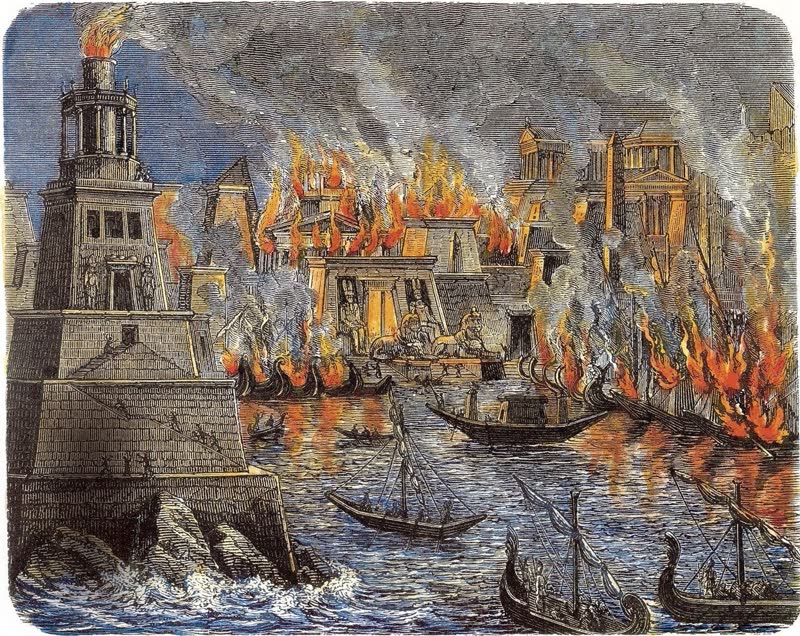
What We Actually Lost: The Silence at the End of the Catalog
Measuring the losses from the Library of Alexandria is an exercise in confronting absence — in listening for books whose titles survive but whose words do not. Some of what was lost can be named. Sappho, the lyric poet of Lesbos who wrote some 10,000 lines of verse, was collected into nine books in Alexandria. Roughly 650 lines survive today: less than seven percent of her output. We have her most celebrated fragments — the burning jealousy of "He seems to me equal to the gods," the tenderness of the Hymn to Aphrodite — but we are missing eight and a half of those nine books, and we do not know what she wrote in them.
We are missing Eratosthenes's geographical treatise, in which he described his measurement of the Earth and laid out his conception of the inhabited world — a work we know only through later summaries. We are missing Aristarchus's heliocentric manuscript, which articulated the correct model of the solar system roughly 1,800 years before Copernicus. We are missing Herophilus's anatomical texts, the first systematic human dissection records, which might have advanced medicine by centuries. We are missing the full Pinakes of Callimachus, the catalog of a library we are still trying to reconstruct from its ruins.
And we are missing what the historian Garrett Ryan has called "the residue and introspection of an extremely sophisticated literary culture" — the commentaries, the monographs, the scholarly debates, the minor poets and local historians whose names appear in passing references and then nowhere else. These were not the masterpieces. They were the texture of a civilization's intellectual life, the footnotes and field notes that make the masterpieces legible. Without them, we are reading the ancient world the way we would read a library whose catalog had been destroyed: guessing at what was there from the few books that happened to survive.
Hypatia and the Last Lamp
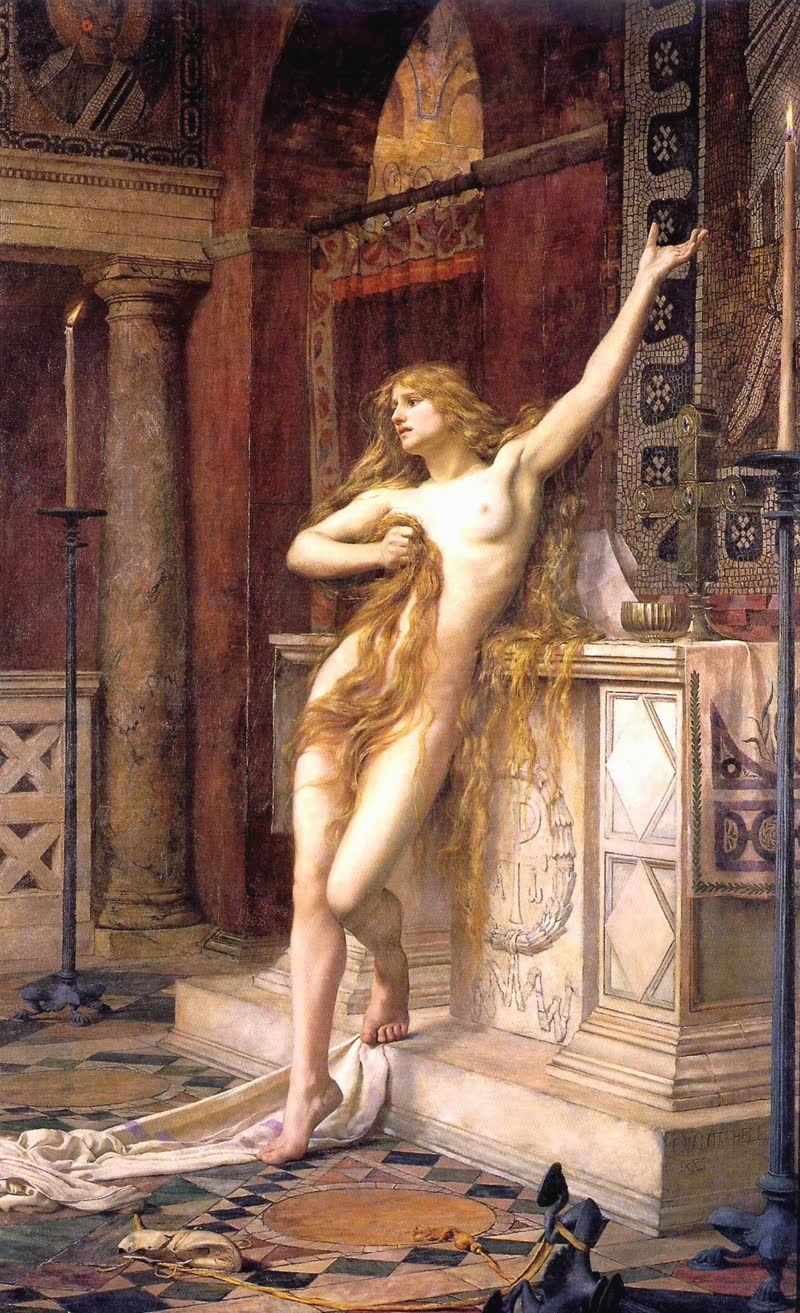
No figure stands at the intersection of the Library's legacy and its loss more hauntingly than Hypatia of Alexandria (c. 350–415 AD) — mathematician, philosopher, astronomer, and the last great scholar produced by Alexandria's intellectual tradition. Born to Theon of Alexandria, himself a mathematician who wrote commentaries on Euclid and Ptolemy, Hypatia went beyond her father's work to become the recognized head of the Neoplatonist school in the city, drawing students from across the Mediterranean world.
She wrote commentaries on Apollonius of Perga's Conics, on Diophantus's Arithmetic — foundational texts of geometry and what would become algebra — and on Ptolemy's astronomical tables. Her goal, like her father's before her, was preservation: to take difficult, aging manuscripts and annotate them clearly enough that future generations could read and use them. She was, in the most literal sense, a keeper of the archive at its twilight hour.
In March 415 AD, a Christian mob seized Hypatia from her carriage on a street in Alexandria, dragged her to a church, and murdered her with brutal violence before burning her remains. Her death has long been read as a symbolic end of the classical world — paganism extinguished, reason supplanted by dogma, the library's last light snuffed out. The reality is more nuanced but no less painful. Hypatia died in a city already diminished, already stripped of most of what the Mouseion had housed. She was not the last scholar of Alexandria; she was the most visible one, and she paid with her life for working in a world that had grown hostile to the kind of knowledge she preserved.
Her writings are lost. None of her commentaries survive in their own right. We know her work primarily through the letters of her student Synesius of Cyrene, who wrote to her as "my revered teacher" and credited her with the intellectual formation of his life. What Hypatia knew about the mathematics and astronomy she spent her career annotating, we cannot say. We have her reputation, and the echo of her absence.
The Library and the Archive: Knowledge as a Puzzle
For players of The Archivist, the Library of Alexandria is more than historical backdrop — it is a mirror of the game's own central obsession: the fragility of organized knowledge, and the strange pleasure of recovering what has been scattered. The word archive itself descends from the Greek arkheion, the residence of the magistrate who held civic records — the place where documents were kept precisely because they needed to be kept, because the world left to itself tends to lose things.
The Mouseion's scholars understood this. That is why Callimachus built the Pinakes: not just to help readers find scrolls, but to assert that knowledge had a structure, that texts could be organized, compared, and retrieved rather than simply accumulated. The Pinakes was itself a kind of puzzle — a vast indexing of what was known, cross-referenced by genre, author, and subject. To read it would be to hold a map of the ancient world's intellectual geography. That it no longer exists is one of the Library's cruelest subtractions.
When you work through a word puzzle in The Archivist — teasing apart anagrammed letters, reconstructing a familiar word from its scattered components — you are doing something the scholars of the Mouseion would have recognized: taking fragments and restoring them to legibility. The archive's deepest work is always reconstruction. What survives of the ancient world came to us through acts of patient recovery — monks copying manuscripts in cold scriptoria, Arab translators rendering Greek science into Arabic, Byzantine scholars preserving texts that Europe had forgotten. Every word that reached the modern world did so because someone, somewhere, decided it was worth keeping.
The Question the Library Leaves Open
There is a temptation, when writing about the Library of Alexandria, to treat its loss as a fixed catastrophe — something that happened in the past, whose consequences are settled and whose lessons are simple. But the Library's story resists that kind of closure. We do not know exactly what was in it. We do not know how much was lost and how much survived by being copied elsewhere. We do not know whether Aristarchus's heliocentric manuscript would have changed the course of astronomy, or whether it would have been ignored in Alexandria as it was ignored in the city where it was written.
What we do know is this: the Library was built on the premise that knowledge was worth the effort of preservation — that gathering and organizing the intellectual output of civilization had intrinsic value, regardless of immediate practical use. For several centuries, successive rulers agreed. Then they stopped. And when they stopped, the building that housed the premise deteriorated with it, fire by fire, decade by decade, until the scrolls that had once held Aristarchus's model of the solar system and Sappho's missing eight books and Herophilus's anatomical records were — where? Burned? Decayed? Scattered across a Mediterranean world that had stopped keeping track?
The Library of Alexandria is not only a monument to what was lost. It is a monument to what it costs to keep things. Every archive is an argument, renewed daily, that the past is worth the trouble of carrying forward. When that argument loses, it loses quietly — not in a single dramatic fire, but in ten thousand small decisions to allocate resources elsewhere, to let the cataloging lapse, to assume that someone else will handle the preservation. The greatest library the ancient world ever built did not go dark all at once. It dimmed, shelf by shelf, until one day there was nothing left to read.
The dust still settles. The wax seals on the unfound scrolls remain unbroken. And somewhere in the shadows of what we do not know, the Alexandrian archive persists as an invitation: keep searching, keep translating, keep asking what has been lost and whether it might, somehow, be found.